Atomic Habits
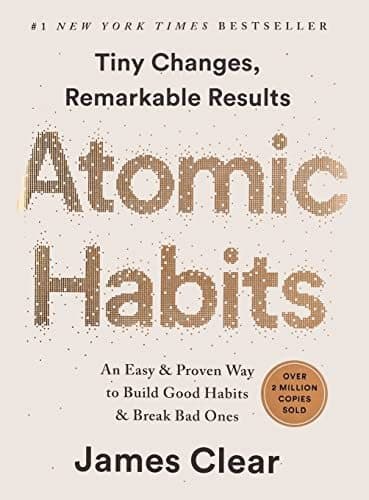
Tiny changes, remarkable results — habits compound like interest.
The big idea
Clear argues that goals don't drive long-term success — systems do. Habits are the compound interest of self-improvement: 1% better every day produces a 37x improvement over a year. He breaks habit formation into a four-step loop (cue, craving, response, reward) and offers practical levers for each step. Identity-based change is the engine: instead of trying to do something, become the kind of person who does it. Environment design beats willpower.
Make it obvious, attractive, easy, and satisfying — the Four Laws of Behavior Change.
Dave Brailsford had a problem. When he took over British Cycling in 2003, no British rider had ever won the Tour de France in the 110-year history of the race. The team had managed only one Olympic gold medal in nearly a century. Brailsford committed to what he called the aggregation of marginal gains — the philosophy of searching for a tiny margin of improvement in everything you do.
Focus on systems, not goals. Goals set direction; systems produce progress.
On a March afternoon in James Clear's sophomore year of high school, a teammate's baseball bat slipped from his hands during a swing and slammed into Clear's face at full speed. His skull was fractured in three places. Both eye sockets shattered. He was put into a medically induced coma. Doctors told his parents he might not survive the night.
Identity drives behavior: 'I am a runner' beats 'I want to run more.'
In 1965, a Hungarian psychology graduate student named László Polgár wrote a manifesto arguing that any healthy child could be raised to genius if trained intensively from before age five. He couldn't find anyone willing to bet on the theory, so he raised three daughters as the experiment. He chose chess because the result is unambiguous — you win or you lose, and your rating is a number.
The two-minute rule: scale any new habit down to something that takes under two minutes to start.
Twyla Tharp, the choreographer behind Push Comes to Shove and Movin' Out, has a single ritual she considers the foundation of her career. Every morning at 5:30am she walks out of her Manhattan home, hails a cab, and tells the driver to take her to the Pumping Iron gym on East 91st Street. She doesn't think about the workout. She just gets in the cab.
Habit stacking: anchor a new habit to an existing one — 'after I pour my coffee, I will meditate.'
In 1997, Stanford behavior scientist BJ Fogg formalized something he'd noticed about his own life: he was great at flossing his front two teeth and terrible at flossing the rest, because he'd built the front-two flossing onto an existing routine — toothbrushing — and never built the rest. He spent the next two decades testing the principle. The result became Tiny Habits, the methodology Clear borrows from in Atomic Habits.
Environment is the invisible hand: design your space to make good habits the path of least resistance.
In October 2009, on a Stockholm subway escalator at the Odenplan station, Volkswagen's Fun Theory team replaced the adjacent staircase with one that played piano notes when stepped on. They installed the piano keys overnight and filmed for 24 hours. Stair use jumped 66% over normal — even though the escalator was right there, free, and faster.
Never miss twice. One slip is an accident; two slips is the start of a new habit.
A 1999 study in the Journal of Sports Sciences tracked competitive swimmers across a season, recording every workout missed and every outcome at year-end. The result was small but counterintuitive: swimmers who missed a single workout performed identically to those who hadn't missed any. Swimmers who missed two consecutive workouts were twice as likely to drop out of the program within the month.
The takeaway
Clear's gift is replacing willpower as the protagonist of self-improvement. Once you see habits as compound interest and identity as the engine, the question stops being 'how do I motivate myself?' and becomes 'what system would make this inevitable?' You leave thinking less about the next big change and more about the next 1% — and the cab ride that gets you to the gym.