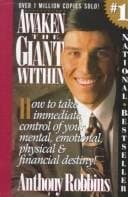
Awaken the Giant Within
Decisions, not conditions, shape destiny.
The big idea
Robbins synthesizes neuro-linguistic programming, classic conditioning, and personal development into a sweeping system for changing emotional patterns. The leverage point is decisions — most people 'try' or 'should' but never decide. By linking massive pain to old patterns and massive pleasure to new ones, you rewire what you do automatically. The second half maps these tools onto finances, relationships, body, and emotions.
It's in your moments of decision that your destiny is shaped.
In 1981, Tony Robbins was 21, weighing 38 pounds more than his frame should hold, living in a 400-square-foot bachelor apartment in Marina del Rey, washing dishes in his bathtub because he had no kitchen sink for them. He'd been earning $38,000 a year and spending $42,000. One night on the beach he made what he calls his moment of decision.
Change happens when staying the same becomes more painful than the change.
Robbins's leverage principle: humans don't change because they see the light; they change because they feel the heat. He had a client in his early coaching years who couldn't quit smoking through logic — until they walked through a 20-year visualization of being bedridden, oxygen tube in his nose, missing his daughter's wedding. He stopped that day.
Quality questions create a quality life — what you ask determines what you focus on.
Robbins claims your brain is a heat-seeking missile aimed at whatever question you ask it. 'Why does this always happen to me?' produces a list of grievances. 'What can I learn from this and how can I use it?' produces a path forward. He had clients trapped in depression who shifted their state in weeks just by changing the questions they asked themselves on waking.
Identity is the strongest force — change what you call yourself, you change what you do.
Robbins argues 99% of behaviors flow from identity, and the brain's job is to keep behavior consistent with who you believe yourself to be. He recounts a client labeled 'lazy' since childhood whose entire life was downstream of the label — until she rewrote herself as 'a powerful woman,' and the actions reorganized themselves around the new identity over months.
Model excellence: study people who already have what you want and copy their patterns.
Robbins's approach — Neuro-Associative Conditioning — borrows from NLP founders Richard Bandler and John Grinder. Find someone with the result you want, study their physiology, beliefs, internal language, and strategies, then install the same patterns in yourself. He claims to have cured combat veterans of phobias in a single session by modeling people who'd successfully overcome the same fear.
Rituals beat motivation — design daily ones for body, mind, and emotion.
Robbins's morning hour is choreographed: cold plunge to 57°F for three minutes, a breathing pattern he calls priming, gratitude visualization on three specific items, then incantations — affirmations spoken with full physiology. The combination shifts state on demand, regardless of what's happening externally. He insists motivation is a byproduct of state, not its cause.
Standards rise and fall together — raise one (fitness) and others tend to follow.
Robbins recounts a client, a Manhattan attorney who started running every morning at 5am as a fitness goal — and within six months had renegotiated his marriage, fired three difficult clients, and raised his rates 40%. The fitness wasn't the cause. It was the proof of concept that a higher floor was possible in one domain, after which the others became intolerably low.
The takeaway
Robbins's gift is the visceral reframing of decision as amputation — de-caedere, to cut off — and the recognition that change happens not when we see the light but when we feel the heat. Identity is the strongest force in the personality, ratified by action rather than declaration, and standards rise and fall together. You leave with one standard chosen for the quarter and the question 'what can I learn from this' replacing 'why does this always happen to me.'