Big Magic
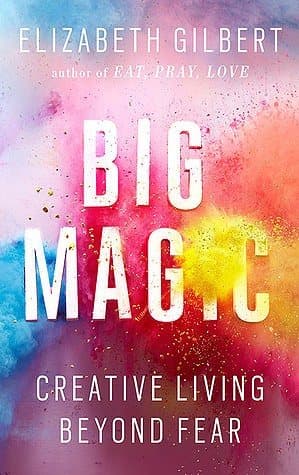
Creative living, beyond fear, with curiosity as the steering wheel.
The big idea
Gilbert (Eat Pray Love) makes the case for creativity as a birthright, not a profession. Inspiration is treated almost as a living force that visits people willing to do the work; perfectionism, scarcity thinking, and 'I'm not a real artist' stories shoo it away. She asks readers to follow curiosity over passion (passion can feel paralyzing), and to make things for the joy of making, not for validation.
Follow curiosity over passion — passion is loud; curiosity is patient.
After Eat Pray Love sold ten million copies in 2006, Elizabeth Gilbert spent years fielding the same anguished question on tour: 'I don't know what my passion is.' She started giving a different answer. Her own next book, The Signature of All Things, didn't come from passion. It came from a small curiosity about her grandmother's old gardening books — a thread she pulled for two years before noticing it had become a 500-page novel about a 19th-century botanist.
Done is better than good — perfectionism is fear in fancy clothes.
Gilbert finished Eat Pray Love in 2005 knowing several chapters were uneven. Her editor at Viking, Paul Slovak, asked if she wanted another pass. She said no. The book shipped flawed and sold ten million copies; the perfect version, still in a drawer, would have sold zero. Gilbert tells this story to make a point about the costs of polish: every month spent perfecting is a month the work doesn't exist in the world.
Make space for inspiration; it visits people who show up regularly.
Gilbert tells the story of her friend, the poet Ruth Stone, who grew up working in the fields of rural Virginia. Stone described feeling poems thunder across the landscape toward her — and if she didn't run home and grab a pencil fast enough, the poem would pass through her and find another poet. Stone learned to keep paper in her apron pocket. Gilbert frames the bargain: ideas visit those who show up, but they don't wait.
Don't quit your day job — financial pressure makes art worse, not better.
Before Eat Pray Love, Gilbert worked as a waitress at a Philadelphia diner, a ranch cook in Wyoming, and a clerk at a New York bookstore. She wrote in the early mornings before her shifts. She insists this preserved the work — when art doesn't have to pay the rent, you can write what you actually want, not what you hope will sell. Her three books before Eat Pray Love were paid for, in essence, by tips and short-order cooking.
Your creativity is worth doing even if no one ever pays you for it.
At a Boston reading in 2014, a man approached Gilbert and said he'd always wanted to be a writer and asked what he should do. Her answer: write. Whether anyone publishes you is irrelevant to whether you should write. The work itself reshapes the person doing it; payment is a possible byproduct, not the point. She's given the same answer dozens of times over decades.
The work is the prize — outcomes are bonus.
After Eat Pray Love became a global phenomenon and a 2010 Julia Roberts film, Gilbert's next novel, The Signature of All Things, sold modestly. Headlines asked 'Is she done?' She had to decide whether the work itself was the reward or whether external validation was. She kept writing — because the alternative was making her happiness a hostage to charts she couldn't control.
Be a trickster, not a martyr — creative life shouldn't require suffering.
Gilbert tells of standing in her garden one summer afternoon and hearing a tomato 'whisper' a novel idea to her. She laughed out loud at her own absurdity, then went inside and wrote the opening scene. She contrasts this with the Romantic-era artist myth — Plath, Woolf, Hemingway — that bound art to suffering, often fatally. The tomato-whispering laugh, she insists, kept her productive when seriousness might have stopped her.
The takeaway
Gilbert's gift is detaching creative life from suffering and outcomes. Through Ruth Stone running across Virginia fields to catch poems before they passed through her, and Gilbert herself shipping the imperfect Eat Pray Love rather than perfecting it in a drawer, you learn that curiosity is a gentler engine than passion and that the work itself is the prize. You leave keeping the day job, following small interests instead of waiting for thunderclap callings, and choosing the trickster's lightness over the martyr's cape.