Dare to Lead
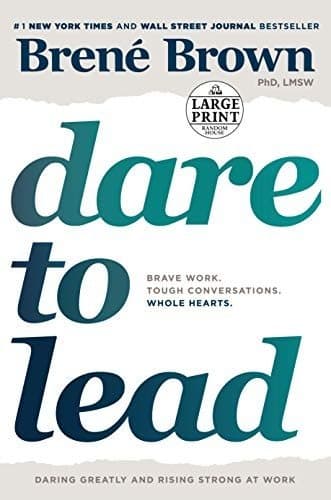
Daring leadership is courage built from vulnerability — not the absence of fear, but the willingness to choose courage in spite of it.
The big idea
Brown brings two decades of social-science research on shame, vulnerability, and courage to bear on the question of what makes leaders effective. Her central claim is that the leadership behaviors organizations most need — clear feedback, hard conversations, ethical decisions, real innovation — all require vulnerability, and that most leaders armor up to avoid the discomfort vulnerability demands. The book is built around four skill sets: Rumbling with Vulnerability, Living into Our Values, Braving Trust, and Learning to Rise.
Daring leadership starts with rumbling with vulnerability — not avoiding it.
Brown describes a meeting with a group of senior special operations leaders that catalyzed the book. She had been invited to discuss her research on vulnerability and assumed the room would push back hard on the idea that vulnerability was central to leadership. Instead, one of the most senior officers in the room said: 'We can't ask our people to be brave if we don't model vulnerability ourselves.' The room nodded. Brown left convinced she had to write the book she had been avoiding.
Armored leadership versus daring leadership: knowing the difference.
Brown's research team coded interview transcripts of leaders across industries and identified sixteen specific behaviors that distinguish armored leadership from daring leadership. Armor includes perfectionism, blame, cynicism, leading from hurt, and the use of fear and power as motivators. Daring includes modeling clear contracts, extending generosity, leading from heart, and the willingness to say 'I don't know.'
BRAVING: trust is built in increments through seven specific behaviors.
Brown reports that 'trust' was the single most-cited concept in her interviews with leaders, and the least operationalized. Everyone wanted more trust. Almost no one could define what trust meant in concrete behaviors. Her team built the BRAVING framework to break trust down into something measurable: Boundaries, Reliability, Accountability, Vault, Integrity, Non-judgment, and Generosity.
Living into our values: when values conflict, decide in advance which one wins.
Brown's research found that most organizations have ten to fifteen stated values painted on the wall. Her data: organizations with more than two operating values have effectively zero. The list becomes a marketing artifact rather than a decision tool. The leaders she studied who actually lived their values had identified, painfully, two values that mattered most when the others were in tension.
Learning to rise: the story you tell yourself about the fall determines whether you get up.
Brown opens the final section with Theodore Roosevelt's 1910 speech at the Sorbonne, the passage now known as 'The Man in the Arena.' She quotes it deliberately. The credit, Roosevelt argued, belongs not to the critic but to the one whose face is marred by dust and sweat and blood. The arena is where the work of leadership happens, and falling — failing publicly, painfully — is part of the price of being in the arena at all.
The takeaway
Brown's gift is two decades of research proving that vulnerability is not the opposite of courage — it's the measure of it. The leadership behaviors organizations most need all require the armor to come off, as the special ops officer who told her 'we can't ask our people to be brave if we don't model vulnerability' settled. You leave with a different operating principle: clear is kind, unclear is unkind. Choose the harder rumble; the marble jar of trust fills slowly, deposit by deposit.