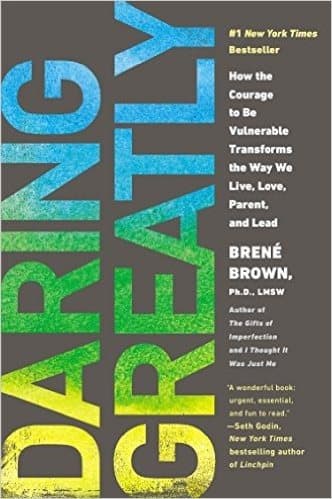
Daring Greatly
Vulnerability isn't weakness — it's the birthplace of courage.
The big idea
Drawing on a decade of qualitative research on shame and vulnerability, Brown argues that wholehearted living requires showing up without armor. Most of us armor up to avoid the discomfort of being seen — and in doing so, cut ourselves off from love, creativity, and trust. Daring greatly means choosing to be in the arena despite the risk of failure or judgment, because that's where everything meaningful happens.
Vulnerability is the core of meaningful relationships — and the path through fear.
On April 23, 1910, at the Sorbonne in Paris, Theodore Roosevelt delivered the speech he'd later call his greatest. He'd just left the presidency a year earlier and the line he gave about the man in the arena, face marred by dust and sweat and blood, became the spine of Brené Brown's career a century later. She titled the book Daring Greatly from a phrase in that paragraph.
Shame says you are bad; guilt says you did something bad. Guilt is useful, shame is corrosive.
Brown's research at the University of Houston Graduate College of Social Work drew the distinction sharply. Guilt holds behavior up against values — 'that wasn't who I want to be' — and motivates change. Shame holds the self up as defective — 'I am bad' — and motivates hiding. The neuroscience differs: guilt activates the anterior cingulate cortex, shame activates the same regions as physical pain.
Scarcity culture — never enough, never good enough — fuels disengagement.
Brown opens the book with the 21st-century mantra she heard everywhere in interviews: not safe enough, not certain enough, not perfect enough, not extraordinary enough. The first thought of the day for many subjects was 'I didn't get enough sleep'; the second, 'I don't have enough time.' Scarcity, she argues, is the soundtrack of disengagement and the engine of every modern feed.
Wholeheartedness: cultivate authenticity, self-compassion, gratitude.
Brown's research over six years filtered her interview subjects into a smaller subset she called the wholehearted — people who lived from a deep sense of worthiness, who believed they were worthy of love and belonging now, not after some achievement. They weren't the luckiest; many had survived devastating loss. What distinguished them was a refusal to barter their worth against future outcomes.
Disengagement is the most dangerous response to fear in relationships.
Brown argues the opposite of love isn't hate — it's disengagement. When parents stop showing up at games, partners stop asking about the day, employees stop offering ideas. That's the moment relationships begin to die. Conflict is usually recoverable. Absence is usually not.
Trust is built in the smallest moments — marble jar moments.
Brown's daughter Ellen came home third-grade-distraught after classmates betrayed a secret she'd told them. Her teacher kept a marble jar — marbles for collective good behavior, marbles taken away for poor. Brown borrowed the metaphor that night to explain friendship: trust isn't a single grand act but hundreds of small marbles dropped in. And it can drain as quietly as it filled.
If you're not in the arena getting your ass kicked, your feedback doesn't count.
After Brown's June 2010 TEDxHouston talk on vulnerability went viral — eventually crossing 60 million views — the comments section attacked her appearance, her credentials, her motives. She had a small breakdown that ended in her therapist's office. The therapist gave her the assignment that became the one-by-three card.
The takeaway
Brown's gift is the research-backed inversion that vulnerability is not weakness but the birthplace of courage — the only doorway through which love, creativity, and trust enter. Roosevelt's man in the arena is the model; the one-by-three card in your wallet, naming the few whose feedback you'll actually let in, is the practical defense. You leave knowing that trust is built in marble-jar moments, not grand gestures, and that disengagement, not conflict, is what kills the things you love.