David and Goliath
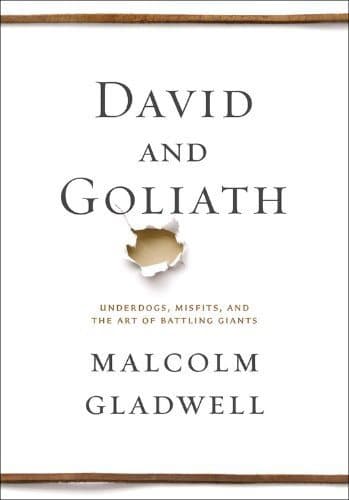
Underdogs win more than they should — because the very things that look like weakness are often where the real advantage hides.
The big idea
Gladwell argues that we systematically misread the contest between the powerful and the powerless. The giant's size, the elite school, the heavy hand of authority, the extra dollar of wealth — each looks like an unambiguous advantage, yet each carries a hidden cost that the strong rarely see and the weak learn to exploit. He builds the case across an inverted-U curve, where more of a good thing first helps, then stops helping, then actively hurts, and through the idea of 'desirable difficulty,' where a disadvantage like dyslexia or early hardship forces compensations that become superpowers.
The giant's strength is often the seed of his defeat: read the contest, not the size.
Roughly three thousand years ago, two armies faced each other across the Valley of Elah, the Philistines on one ridge, the Israelites on the other, neither willing to descend into the valley and surrender the high ground. To break the stalemate the Philistines sent down their champion, Goliath — a giant in bronze armor who bellowed for a single Israelite to fight him in one-on-one combat. For forty days no one came forward. Then a shepherd boy who had been delivering bread to his brothers volunteered.
More is not always better: every advantage runs along an inverted-U curve.
Teresa DeBrito ran the Shepaug Valley middle school in one of the wealthiest corners of Connecticut, and she was worried — not about overcrowding, but about emptiness. Enrollment was falling, classes were shrinking, and every parent assumed that meant a better education for their children. DeBrito, who had spent decades in classrooms, suspected the opposite. A class can get too small to crackle, too quiet to argue, too thin to carry a struggling student on the energy of the group.
Big fish, little pond: where you stand beats how good you are.
Caroline Sacks loved science the way some children love music — from the time she could draw, she was sketching animals and dissecting the world around her. She finished near the top of her high school class, aced her sciences, and was accepted to her dream school, Brown University, over her safer option, the University of Maryland. It was, by every conventional measure, the right choice. It nearly ended her life in science.
Desirable difficulty: hardship can force the very skills that become a superpower.
Dyslexia is, by any reasonable account, a disadvantage — and a punishing one. It crowds the ranks of struggling readers, school dropouts, and prison inmates. Yet it also turns up at a startling rate among the very successful: a striking share of self-made entrepreneurs report being dyslexic. Gladwell's question is not whether dyslexia is good — it plainly is not — but whether some people succeed not in spite of it but because of what they were forced to do to get around it. He calls these compensations 'desirable difficulties.'
Power has limits: force without legitimacy breeds defiance, not order.
When the British Army arrived in Northern Ireland in 1969, Catholics in Belfast initially welcomed the soldiers as protectors. Within a year the relationship had curdled. General Ian Freeland imposed the Lower Falls curfew in 1970, sealing thousands of residents in their homes for days under a haze of CS gas while troops ransacked houses for weapons. The show of overwhelming force did not pacify the neighborhood. It radicalized it — and handed the IRA a generation of recruits.
The takeaway
Gladwell's gift is a new pair of glasses for looking at any lopsided contest. Strength and weakness are not fixed quantities but positions on a curve, and the advantage you envy in someone else may be quietly working against them while the hardship you pity is forging a skill. Once you learn to ask where on the inverted-U a person or institution actually stands — and whether their power rests on legitimacy or only on force — the world's giants start to look a great deal more vulnerable, and its underdogs a great deal more dangerous.