Deep Work
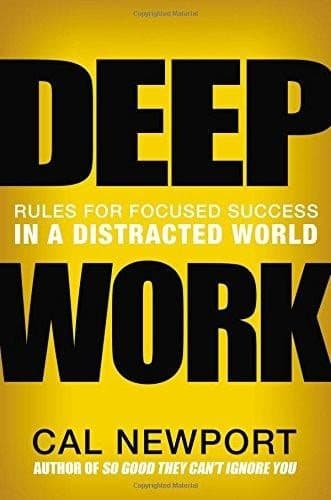
The ability to focus without distraction is becoming both rare and valuable.
The big idea
Newport argues that focused, cognitively demanding work — deep work — is the new superpower of the knowledge economy. Most people fill their days with shallow work (email, meetings, Slack), which is easy to replicate and hard to feel proud of. Through rituals, schedules, and a hard line on distraction, anyone can train the capacity for sustained focus and produce work that matters.
Deep work = professional activity in a state of distraction-free concentration.
In 1922, the Swiss psychiatrist Carl Jung began constructing a stone tower at Bollingen on the upper Lake Zurich. He kept no electricity, no phone, and a deliberate distance from his Zurich practice. Each morning he locked himself in a private office and worked uninterrupted for two hours on his most important psychology — the writing that would produce his theories of archetypes and the collective unconscious. The tower was the architectural expression of his theory of focused work.
Schedule deep work blocks like meetings — protect them ruthlessly.
Newport profiles Adam Grant, who became the youngest tenured professor at Wharton at age 28 by stacking his teaching into one semester and his writing into another, with effectively zero meetings during writing periods. The bimodal schedule produced four New York Times bestsellers and over 60 academic papers in less than a decade — an output most senior professors don't reach in a lifetime. Grant's secret was structural rather than heroic: he never had to summon focus on demand because he had carved out blocks where focus was the default.
Embrace boredom — your brain needs to relearn how to sit without stimulation.
Newport's example: don't take out your phone in line at the grocery store, on a walk, or waiting for an elevator. Each minor reach for novelty is a rep training your brain to crave switching, which is exactly the wiring deep work requires you to undo. The exercise he recommends is to schedule the use of distraction rather than the use of focus — distraction allowed during pre-defined windows, banned otherwise.
Quit social media, or at least audit which platforms genuinely serve your goals.
Newport applies what he calls the craftsman approach to tools: like a blacksmith with hammers, only adopt a tool if its core benefits substantially outweigh its costs. He recounts trying a 30-day social media blackout and finding most platforms failed the test entirely — the reasons he had been giving for staying ('I might miss something useful') turned out to be rationalizations rather than reasons.
Drain the shallows: cap shallow work as a percentage of your day.
Boston Consulting Group hired Harvard sociologist Leslie Perlow to study why their consultants felt perpetually overwhelmed. Perlow proposed an experiment that BCG initially resisted: mandatory 'predictable time off' from email one weeknight per week, no exceptions, no client backchannel. The team feared client backlash. Instead, satisfaction soared, work quality improved, and clients didn't notice — they didn't notice because the constraint had forced better planning and shorter, sharper communication.
Rituals reduce friction — same place, same time, same routine.
When J.K. Rowling was finishing the final Harry Potter book in 2007 under enormous pressure, she checked into the Balmoral Hotel in Edinburgh, took a single suite, and wrote there for weeks until the manuscript was done. She still keeps the room. Newport profiles her as one of many high-output writers who deliberately remove themselves from their normal environment to construct a ritual the brain reads as 'this is when I write.'
Use 'fixed-schedule productivity' — set a hard end time and work backwards.
Radhika Nagpal, a roboticist at Harvard, wrote an essay in 2013 about how she had become a tenured professor while working what she explicitly called 7-to-7 fixed hours, refusing email after dinner, taking weekends off, and traveling internationally only twice a year. The essay went viral among academics because the conventional path to tenure assumed seventy-hour weeks; Nagpal had achieved it on forty-five.
The takeaway
Newport's gift is naming the rare and valuable thing — sustained, distraction-free concentration — and arguing that it is built by ritual and structure, not by heroic willpower. Jung's stone tower and Adam Grant's bimodal calendar are the same insight: protect the cognitive bandwidth like a meeting on the books, then drain the shallows around it. You leave skeptical of any tool that fails the craftsman test and committed to a 90-minute block the world is not allowed to touch.