Ego Is the Enemy
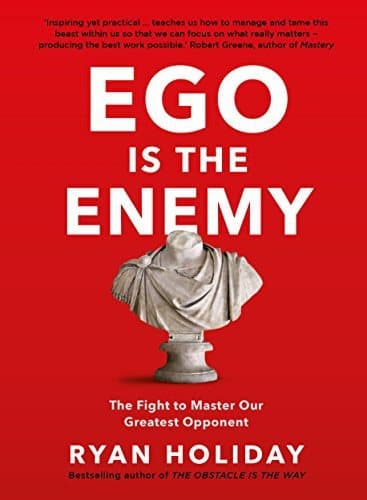
Your worst enemy already lives inside you — the constant need to be recognized, validated, and right, quietly sabotaging the work that could have made you great.
The big idea
Ryan Holiday wrote Ego Is the Enemy as a kind of armor against his own early success, and built it around a single observation: at every stage of any pursuit, our own ego is the most reliable saboteur. He divides life into three seasons — when we aspire to something, when we attain it, and when we fail — and argues that ego attacks differently in each, inflating us as we climb, blinding us at the summit, and embittering us when we fall.
Ego is the enemy at every stage: when you aspire, when you succeed, and when you fail.
In the spring of 1864, William Tecumseh Sherman was handed command of the Union armies in the West, the position he had spent the war circling. What is striking is how hard he had worked to avoid it. Early on he had begged not to be given top command, telling Lincoln he would rather serve under someone else, and when ambitious men around him grasped for glory and headlines, Sherman distrusted the same urge in himself. Two decades later, when his name was floated for president, he killed the idea with a single sentence: if nominated he would not run, and if elected he would not serve.
Talk less, do more: announcing your plans spends the energy the work itself requires.
Holiday describes a familiar character: the person with a big idea who, at every dinner and every party, tells you all about it. The plan is bold, the vision detailed, and describing it feels wonderful — people nod, they are impressed, and for a moment the talker gets to feel like exactly the kind of person who does great things. The trouble is that the feeling is a counterfeit of the real one, collected before any work has been done.
To be or to do: choose doing work that matters over being someone who is admired.
John Boyd was one of the most consequential military thinkers of the twentieth century. As a fighter pilot he earned the nickname 'Forty-Second Boyd' for his standing bet that he could beat any opponent in simulated air combat within forty seconds; later his Energy-Maneuverability theory reshaped how fighter jets were designed, and his ideas shaped the F-15 and F-16. Yet he retired a colonel, never grew rich, often wore the same rumpled clothes, and gave away credit for work that could have made him a household name.
Stay a student: the pretense of knowledge is what stops you from getting any better.
By the mid-1980s Kirk Hammett was the lead guitarist of Metallica, one of the biggest bands in the world, with millions of fans who already regarded him as a virtuoso. So it is telling that he went and signed up for lessons. He studied under the guitarist Joe Satriani, submitting himself to a teacher, being corrected, drilling fundamentals — choosing to be a beginner again at the exact moment the world had decided he had nothing left to learn.
Alive time or dead time: failure is raw material, neutral until you decide what to do with it.
In 1946, a young man named Malcolm Little was sent to prison for burglary, twenty years old and barely able to read beyond what the streets had taught him. He could have served the sentence the way most people serve time — passively, resentfully, waiting for it to end. Instead he began to read, and when he found he didn't have the vocabulary to understand the books, he got hold of a dictionary and copied it out by hand, page after page, word after word, until he had taught himself to read and to think.
The takeaway
Holiday's gift is a working definition of humility that has nothing to do with weakness: ego is not confidence but the need to be recognized, and it is precisely that need that gets in the way of doing great work. The reader comes away with a practical suspicion of how good it feels to be admired — and a reminder that the quiet, unglamorous path of the doer tends to outlast the loud, decorated path of the somebody.