Emotional Intelligence
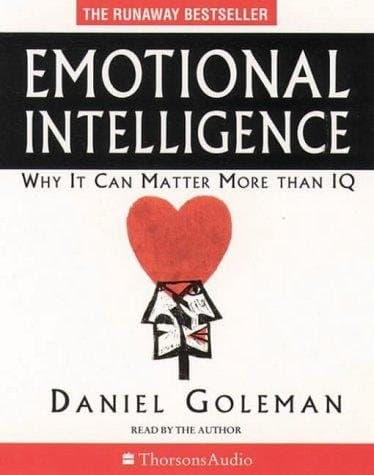
EQ predicts success more reliably than IQ — and unlike IQ, it can be grown.
The big idea
Goleman synthesized brain research and psychology to popularize emotional intelligence: self-awareness, self-regulation, motivation, empathy, and social skills. Where IQ sets a baseline, EQ explains who actually thrives — in jobs, relationships, leadership. The book maps the neuroscience (amygdala hijack, prefrontal cortex), describes the consequences of low EQ, and offers practices for raising it at any age.
Five domains: self-awareness, self-regulation, motivation, empathy, social skills.
Daniel Goleman's framework drew from Peter Salovey at Yale and John Mayer at the University of New Hampshire, who'd published the original 'emotional intelligence' construct in a 1990 academic paper. Goleman expanded it into a five-domain cluster after profiling executives at companies including PepsiCo, Lucent, and the U.S. Air Force. He saw a pattern: brilliant technical leaders stalled because they couldn't read a room or control their tempers.
Amygdala hijack: emotion fires faster than reason — pause before responding.
Goleman's signature concept came from Joseph LeDoux's research at NYU, which mapped two pathways from sensory thalamus to amygdala. The 'low road' bypasses cortex entirely — sensory input reaches amygdala in 12 milliseconds, triggering fight-or-flight before the slower 'high road' through cortex (about 30-40 ms) catches up. The amygdala can hijack behavior milliseconds before any conscious thought intervenes.
Naming an emotion reduces its grip — 'I'm anxious' weakens anxiety.
UCLA neuroscientist Matthew Lieberman ran a now-famous fMRI study published in Psychological Science in 2007. Subjects shown angry faces had spiking amygdala activity. When asked to label the emotion ('he's feeling angry'), amygdala activity dropped measurably while right ventrolateral prefrontal cortex lit up. Lieberman called the principle 'affect labeling' — putting feelings into words physically dampens the limbic alarm system.
Empathy is a muscle, not a trait; it grows with practice and exposure.
Goleman highlights Robert Rosenthal's PONS test — the Profile of Nonverbal Sensitivity — developed at Harvard in the 1970s. The test measures ability to read emotion from face, body, and voice cues. People who scored high were better adjusted, more popular, and happier in relationships. Crucially, Rosenthal found scores improved with deliberate practice across age groups. Empathy isn't allocated at birth.
Self-regulation isn't suppression — it's flexible response, not knee-jerk reaction.
Goleman distinguishes self-regulation from emotional flatness. The point isn't to feel less; it's to choose how you express what you feel. He cites Walter Mischel's famous Stanford marshmallow experiment from the 1960s — preschoolers offered one marshmallow now or two if they could wait fifteen minutes. The kids who could wait went on, in follow-up studies, to higher SAT scores, better careers, and happier marriages.
Optimism is learnable: explanatory style determines resilience.
Goleman draws heavily on Marty Seligman's 1980s work at the University of Pennsylvania. Seligman showed that pessimists explain bad events as permanent ('I always fail'), pervasive ('this ruins everything'), and personal ('it's my fault'). Optimists do the opposite: temporary, specific, and contextual. The pattern, Seligman called explanatory style, predicted resilience across domains.
Leadership is mostly EQ — technical skill gets you in the room; EQ keeps you there.
Goleman's research on senior leaders found that EQ accounted for nearly 90% of the difference between star performers and average ones at top levels — far more than IQ or technical skill. He profiles a brilliant CFO at a global consulting firm who couldn't keep talent: his retention numbers were the worst on the leadership team despite his technical excellence.
The takeaway
Goleman's gift is dismantling the IQ-as-destiny myth and showing that the wiring most predictive of a thriving life is trainable. Through Bobby Crabtree shooting through his daughter's bedroom door in milliseconds and MetLife's optimistic salespeople outselling the credentialed ones by 37%, you see that the amygdala fires before reason and that explanatory style decides who survives setbacks. You leave practicing affect labeling and pre-rehearsed pauses, because EQ isn't who you are — it's what you build.