Essentialism
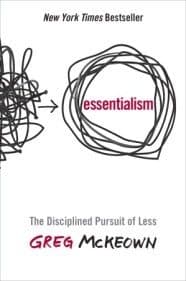
Less but better — the disciplined pursuit of less.
The big idea
McKeown argues that the ability to choose, the conviction that almost everything is non-essential, and the recognition that trade-offs are unavoidable separate the essentialist from the busy. The non-essentialist says yes by default; the essentialist says no by default. The book is about earning the right to focus by relentlessly cutting what doesn't matter, and protecting deep work on what does.
If it isn't a clear yes, it's a clear no — applied to commitments, projects, possessions.
McKeown borrows the rule from musician and entrepreneur Derek Sivers, who in a 2009 essay argued that if you're hesitating about an opportunity, the answer is no. McKeown profiles a former colleague who took a job he was lukewarm about and spent three years climbing out of it. The cost of weak yeses is enormous and invisible until you tally the years.
Trade-offs are inevitable — pretending otherwise just hands the choice to others.
Southwest Airlines in 1971 made an explicit choice: they would be the lowest-cost carrier, which meant explicitly not being a full-service one. No meals. No first class. No hub-and-spoke routing. No assigned seats. The trade-offs were ruthless and visible. While competitors went bankrupt repeatedly, Southwest stayed profitable for forty-seven consecutive years through 2019.
Use a 90% rule: if a decision isn't a 9 or 10 on importance, it's a no.
McKeown insists on rating opportunities on a 1–10 scale. Anything below 9, however attractive, is a no. He gives the example of speaking gigs that look like 7s and 8s — they pay, they flatter, they fill the calendar — but they crowd out the rare 9s and 10s that genuinely matter. Lukewarm yeses bury world-class opportunities.
Protect the asset — sleep, focus, health — that lets you do everything else well.
McKeown describes a partner at a top consulting firm who pulled all-nighters as a badge of honor, billed five hundred hours over the firm's target one quarter, and burned out completely at thirty-five — leaving the field, the city, and eventually the marriage built around the career. The asset he had stopped protecting was the focused mind that produced his work.
Build buffers into estimates — assume things take 50% longer than expected.
The Sydney Opera House was approved in 1957 with a budget of $7 million Australian dollars and a four-year completion estimate. It opened in 1973 — sixteen years later — at a final cost of $102 million. The architect, Jørn Utzon, had quit in 1966 over disputes about cost overruns. The original estimates were not pessimistic enough by a factor of fifteen.
Eliminate what's good to make room for what's great.
Walgreens, before its great chapter, ran a chain of mediocre food-service counters in many of its stores. In the 1990s, CEO Cork Walgreen made the harder decision: kill the food-service business entirely, despite its modest cash flow and decades of history. The freed capital was redeployed to the pharmacy expansion that drove Walgreens' fifteen-year run as the best-performing stock in retail.
The graceful no: 'I can't, but here's who could' is always more useful than guilty over-commitment.
McKeown shares the story of a venture investor who began responding to every cold pitch with 'Let me check my calendar and circle back' even when the answer was already no. The twenty-four-hour delay made the eventual no land more graciously and protected the relationship for future collaboration. The graceful no doesn't lie; it buys the small space needed to honor priorities without rejecting the person.
The takeaway
McKeown's gift is the discipline of saying no by default so the strong yes has a slot to land in. Southwest refused to be a full-service carrier and stayed profitable for forty-seven years; Continental Lite refused the trade-off and the trade-off refused Continental. You leave rating opportunities cold the morning after the flattery, treating sleep as the asset Federer protects with eleven hours, and writing an annual stop-doing list of equal length to the to-do list.