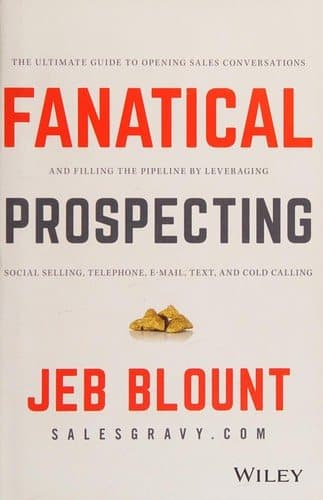
Fanatical Prospecting
The pipe is everything — empty pipes kill more deals than bad pitches.
The big idea
Blount's blunt thesis: most reps fail because they don't prospect enough, period. He calls it 'the universal law of need' — when you need a deal, you'll lose it; only a fat pipe gives you the leverage to walk. The book is unromantic: cold-call discipline, time-blocking the prospecting hour, the 30-day rule (today's prospecting fills the pipe 30/60/90 days out), and refusing to confuse activity with prospecting. It's the antidote to every 'inbound marketing will save us' excuse and a defense of the unsexy work that actually moves quotas.
The 30-day rule: today's prospecting fills the pipe 30, 60, and 90 days from now.
Jeb Blount has spent two decades coaching sales teams across thousands of companies — Fortune 500s, scrappy startups, family-owned distributors. He noticed a recurring pattern in every underperforming rep he reviewed: the rep had stopped prospecting weeks before the dry spell hit. The lag between activity and outcome — typically 30 to 90 days — meant neglect didn't punish quickly. By the time the rep noticed, the next quarter was already lost.
Empty pipe + commission breath = guaranteed lost deals.
Blount calls it 'commission breath' — the verbal tells of a rep who needs this deal: pre-emptive discounts, over-explaining, agreeing to terms that don't make sense, urgency that's about your month-end and not theirs. Buyers detect it instantly. They stop returning calls, or they push for concessions they wouldn't dare ask of a rep with leverage. The smell of desperation, Blount says, sets in before the rep even notices it.
Time-block the Golden Hours — prospect when buyers actually answer.
Blount calls the times when buyers actually pick up the phone the 'Golden Hours' — typically 8-10am and 4-5pm in the buyer's time zone. Most reps spend their best buyer-reachable hours on internal meetings, CRM updates, and admin work, then prospect at lunch and after 5pm when nobody answers. The fix is the simplest performance lever in the book: move the calendar around the customer, not around the company.
Combine channels: phone + email + social + referral, never just one.
Blount's cadence model layers touches across channels: a phone call, then a personalized email referencing the call, then a LinkedIn touch with relevant content, then another call, then a referral ask through a mutual connection. Each touch reinforces the previous one. Reaching the same prospect 6-8 ways over two weeks is how cold prospects warm up — single-channel persistence reads as spam, while multi-channel persistence reads as signal.
Five Cs of social selling: Connect, Consume, Curate, Create, Convert.
Blount's framework for LinkedIn-era prospecting is sequential: Connect (build a relevant network early, before you need it). Consume (read what your buyers are reading). Curate (share useful content others have made). Create (post original perspective regularly). Convert (turn engagement into conversations). Most reps do the first two and skip the rest, which is why their LinkedIn activity doesn't generate pipeline.
Refuse the comfort trap — busy work feels like prospecting but isn't.
Blount's list of comfort-trap activities that masquerade as prospecting: researching the prospect for the fifth time, formatting the CRM with color-coded fields, writing the perfect email template you'll never finish, attending an internal meeting about prospecting goals. Each feels like work. None of it produces a conversation with a buyer. The honest test: did this activity end with a real human responding to me?
Mental toughness is the prospecting skill no one talks about.
Blount frames daily prospecting as mental warfare more than skill training. The script doesn't matter much when you can't pick up the phone. He covers techniques drawn from sports psychology — pre-call rituals, controlled breathing, immediate-recovery routines after rejections — that let reps absorb the no without carrying it into the next dial. The most common cause of underperformance isn't bad technique; it's a slow drift toward avoidance after a rough week.
The takeaway
Blount's gift is the unromantic truth most reps avoid: empty pipes kill more deals than bad pitches, and the 30-day rule punishes neglect on a delay long enough to feel safe and short enough to ruin a quarter. Commission breath is detectable across a phone line; only a fat pipe gives you the leverage to walk. You leave with the discipline to time-block the Golden Hours, layer channels you find uncomfortable, and prospect on the days you don't need to — because that's exactly when the top quartile does.