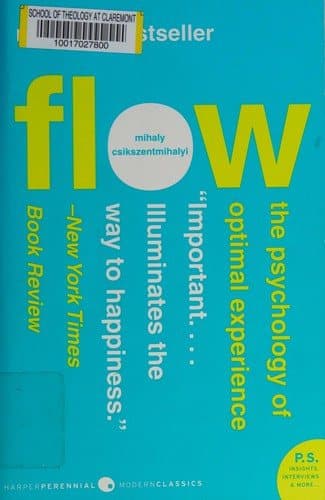
Flow
Optimal experience happens when challenge meets skill exactly.
The big idea
Csikszentmihalyi's decades of research identified a state — flow — in which people are so absorbed in an activity that hours pass like minutes and self-consciousness disappears. Flow happens when difficulty matches ability, feedback is immediate, and goals are clear. The book argues that a good life is largely a sum of flow experiences, and that pleasure (passive consumption) is a poor substitute for the engagement of doing.
Flow needs a clear goal, immediate feedback, and challenge slightly above skill.
Mihaly Csikszentmihalyi — known to colleagues as 'Mike' — survived the Second World War in Hungary as a child watching adults around him collapse psychologically. The question that haunted him afterward: why do some people find meaning in suffering while others fall apart? He pursued the question for fifty years and built one of the most replicated psychological frameworks of the twentieth century.
Passive entertainment rarely produces flow; active engagement almost always can.
Csikszentmihalyi's pager studies surfaced a paradox the participants themselves resisted believing. People watching TV reported flow only thirteen percent of the time, while people working — especially in skilled jobs — reported flow fifty-four percent. Yet the same people, asked which activity they preferred, picked TV. Modern leisure had become passive consumption that reliably underdelivered.
Attention is the most powerful tool we own — flow trains it like nothing else.
Csikszentmihalyi calls attention 'psychic energy' — the most fundamental and limited resource of consciousness. Flow concentrates it so completely that the inner monologue stops, time warps, and self-consciousness disappears. He argues a life is, in a real sense, the sum of what you've paid attention to — and flow shapes attention more than any other state.
The autotelic personality: people who can find flow even in dull conditions.
On a Chicago factory floor in the 1970s, Csikszentmihalyi met Rico Medellin, an assembly-line welder whose job was to perform the same weld on a passing chassis every forty-three seconds. Most workers described the job as soul-crushing. Rico had turned the repetitions into a stopwatch game, beating his own time across the day, then studying electronics at night to prepare for promotion he never quite needed. Asked why, Rico said the boredom would have killed him otherwise.
Rules and structure don't kill flow — they enable it (sports, music, code).
Csikszentmihalyi quotes a chess grandmaster who described his best games as feeling 'like a strong magnetic field' pulling the right move forward; the rules of chess, far from constraining him, gave the field its shape. Without the rules, the same board would have been a meaningless arrangement of pieces.
Work can be more enjoyable than leisure when designed for flow.
Csikszentmihalyi's pager data revealed what he called 'the paradox of work': despite reporting more flow on the job than off it, people insisted they'd rather be off it. The cultural framing of work as obligation overrode the actual subjective experience of doing it. Workers were unhappy in the abstract about hours they had reported as their best of the week.
A meaningful life can be built by stringing together flow activities aligned with a purpose.
Antonio Stradivari's violins still sound unmatched centuries after his 1737 death because every act in his Cremona workshop — selecting wood, cutting, varnishing, stringing — served one converging purpose. The integrated life Stradivari led wasn't compartmentalized; the family who ate dinner with him also assembled instruments with him, and the result was over 1,100 violins of historic quality.
The takeaway
Csikszentmihalyi's gift is naming attention as the only currency that can't be inflated, and showing that a life is the sum of what you've paid it to. Rico the welder turned a forty-three-second weld into a stopwatch game because the autotelic disposition is learnable; rules and structure scaffold the experience rather than constrain it; television delivers low-grade depression in slow motion. You leave auditing your week not by hours logged but by negentropic ratio — and stringing flow toward something the future self will recognize as a Stradivari.