Getting Things Done
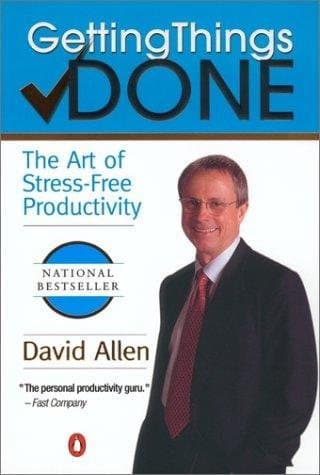
Your mind is for having ideas, not holding them.
The big idea
Allen's GTD system gets every commitment out of your head and into a trusted external system — inbox, projects list, contexts, calendar. The five steps (capture, clarify, organize, reflect, engage) turn open loops into next actions you can act on without re-thinking. The promise: a calm, present mind, because nothing's slipping. The system has a learning curve but rewards stickiness.
Capture everything — every commitment, every idea — into one trusted system.
Allen describes coaching a senior partner at a New York law firm who couldn't sleep past 3 a.m. for years. Not from caffeine — from his brain rehearsing every commitment he hadn't kept. They sat down for a full GTD capture session and ended up with eleven pages of unkept agreements: tax forms, sister's birthday call, a leaking faucet, a borrowed book.
Clarify each capture: is it actionable? If yes, what's the next physical action?
Allen profiles a CEO who had 'launch new website' on his project list for fourteen months. The item never moved because no muscle could move on it — it was a noun phrase, not a verb. Sitting with Allen, he reframed it as 'email marketing director with three competitor sites I admire' and completed that step before the meeting ended.
Two-minute rule: if it'll take less than two minutes, do it now.
“If an action will take less than two minutes, it should be done at the moment it is defined.”Organize by context, not project — 'calls,' 'errands,' 'at computer.'
Allen organizes next actions by where you are and what tools you have: @calls, @errands, @home, @computer, @waiting-for. When you're in the car between meetings, you pull up @calls and execute, regardless of which project the calls belong to. Context-based lists match how attention actually works in real time.
Weekly review is the keystone habit — without it, GTD collapses.
Allen calls the weekly review the 'critical success factor' for GTD: set aside two hours each week to empty inboxes, review every project list, scan calendars two weeks back and forward, and update next actions. Without it, the system silently rots and trust evaporates — because the system only works if you trust it has everything in it.
Projects are anything requiring more than one action — track them separately.
Allen defines a 'project' broadly: anything requiring more than one action step to complete. 'Renew driver's license' is a project. 'Buy birthday gift for Mom' is a project. The definition feels excessive at first but produces a comprehensive Project List of thirty to one hundred items that, once visible, you can prioritize and review systematically.
Stress comes from unkept agreements with yourself — capture-clarify-organize ends most of them.
Allen returns to the New York lawyer with the eleven-page list of unkept agreements — promises to call his sister, file a tax form, fix a leaking faucet, return a borrowed book. None individually large; collectively, an unending background hum. After clarifying or renegotiating each one within a week, his sleep returned.
The takeaway
Allen's gift is freeing the cortex from the rehearsing of what it has agreed to do. The New York lawyer's eleven pages of unkept agreements end his insomnia not by getting completed but by getting captured, clarified, and renegotiated — because the brain is for having ideas, not holding them. You leave with one trusted external system, the imperative-form next action ('call Sarah for cabin recommendations'), and the weekly review as the calibration ritual that keeps the whole apparatus telling the truth.