Good to Great
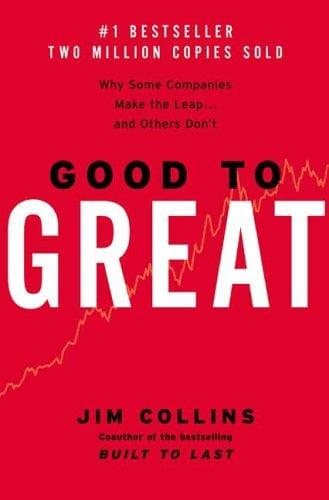
Good is the enemy of great — and the path from one to the other is more disciplined than dramatic.
The big idea
Collins and his research team spent five years studying every Fortune 500 company that made the leap from good to great results — defined as cumulative stock returns of at least three times the market over fifteen years following a transition point. Eleven companies qualified, including Walgreens, Kimberly-Clark, Wells Fargo, Nucor, and Gillette. Each was matched to a comparison company in the same industry that did not make the leap.
Level 5 Leadership: ferocious will paired with personal humility.
In 1971, Darwin Smith was named CEO of Kimberly-Clark, a sleepy paper company that had been trading below book value for two decades. Two months in, Smith was diagnosed with nose and throat cancer and given less than a year to live. He kept working. He survived. And in 1973 he made the most consequential decision in the company's history: he sold the paper mills, including the mill in the company's namesake town, and bet everything on consumer paper products.
First Who, Then What: get the right people on the bus before deciding where to drive it.
When Dick Cooley took over Wells Fargo in 1970, he predicted deregulation was coming and would upend the banking industry. He didn't yet know what the response would be. So he did something unusual: he focused for years on hiring and developing the strongest banking talent he could find, ahead of any specific strategy. When deregulation hit in the 1980s, Wells Fargo was loaded with talent ready to figure out the new rules. The strategy emerged from the people, not the other way around.
The Hedgehog Concept: the intersection of passion, capability, and economic engine.
Collins borrows the metaphor from Isaiah Berlin's essay 'The Hedgehog and the Fox,' itself drawing on the ancient Greek poet Archilochus: 'The fox knows many things, but the hedgehog knows one big thing.' Foxes are clever, fast, and adaptable. Hedgehogs do one thing — roll into a spiked ball — and that one thing wins every encounter. The good-to-great companies, Collins argues, were hedgehogs.
The Flywheel: greatness comes from the cumulative push of consistent action, not a single dramatic event.
Collins offers an extended metaphor: imagine a giant flywheel — a massive metal disk mounted on an axle, twelve feet across, weighing 5,000 pounds. Your job is to get it spinning fast. You push. It barely moves. You push again. It inches forward. After two hours of pushing, you've completed one rotation. You keep pushing. After many hours of consistent pushing, the wheel is moving on its own momentum. Eventually you can't stop it.
Confront the brutal facts — yet never lose faith. The Stockdale Paradox.
Admiral Jim Stockdale was the highest-ranking U.S. military officer held at the Hanoi Hilton during the Vietnam War. He was tortured over twenty times during his eight years of captivity. When Collins interviewed him for the book, Collins asked who didn't make it out. Stockdale's answer was immediate: the optimists. The ones who said, 'We'll be out by Christmas.' Then by Easter. Then by Thanksgiving. They died of broken hearts.
The takeaway
Collins's gift is five years of disciplined research distilling what separates eleven companies that tripled the market for fifteen years from comparable peers that didn't. Level 5 leaders like Darwin Smith at Kimberly-Clark are humble and ferocious, get the right people on the bus before deciding where to drive it, and find the Hedgehog intersection. You leave less interested in dramatic breakthroughs and more interested in the flywheel — the unglamorous, consistent push in the same direction that, viewed from outside, eventually looks like overnight success.