Make Your Bed
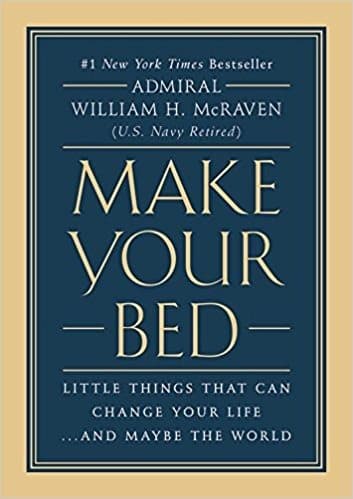
Ten lessons from the brutal crucible of Navy SEAL training — and the first one is as simple as making your bed.
The big idea
Admiral William H. McRaven — a four-star officer who commanded U.S. Special Operations Command and oversaw the 2011 raid that killed Osama bin Laden — built this short book from the commencement address he delivered to the University of Texas at Austin in May 2014. Each chapter draws one life lesson from the six months of Basic Underwater Demolition/SEAL (BUD/S) training he survived in Coronado, California. The premise is deliberately modest: the same habits that carry a soldier through Hell Week scale up to ordinary life. Start the day with one small task completed. Find people to help you paddle.
Start the day with one task completed: it is the small win that sets up every win after it.
On May 17, 2014, William McRaven stood before roughly eight thousand graduating students at the University of Texas at Austin — his own alma mater, class of 1977. He was, at the time, the nine-star career officer running U.S. Special Operations Command, the man who three years earlier had directed the raid on Osama bin Laden's compound in Abbottabad. The speech he gave that day became one of the most-watched commencement addresses ever recorded, and its opening lesson was almost absurdly small.
You cannot go it alone: getting from start to finish takes friends, strangers, and someone to steer.
Much of SEAL training happens in a small rubber boat. Trainees are split into crews of seven and issued an inflatable raft they must carry everywhere — on their heads down the beach, over the dunes, out through the pounding surf off Coronado. Paddle out of sync, and the boat capsizes in the breakers. Lag behind, and the whole crew pays for it.
Life isn't fair — get over being a sugar cookie and keep moving forward.
Every day in training included a uniform inspection. The instructors checked that your cap was starched, your belt buckle gleaming, your uniform pressed. But here was the catch: sometimes, no matter how immaculate you were, the instructors decided you had failed anyway. The standard was not really the standard. The point was the punishment.
Failure can make you stronger: don't be afraid of the circuses.
In BUD/S training, each day's events were graded, and the trainees who underperformed were placed on a list for the 'circus' — two extra hours of grueling calisthenics layered on top of an already exhausting day. The circus was designed to wear you down, to break your spirit, to make you so tired that you would quit before the next morning.
Never, ever quit: whatever happens, don't ring the bell.
In the center of the BUD/S training compound hangs a brass bell. Its purpose is mercy: at any moment, a trainee who has had enough can walk to the bell and ring it three times, and the suffering stops instantly. No more freezing swims, no more pre-dawn runs in the sand, no more Hell Week. Just ring the bell, and you can go home.
The takeaway
McRaven's gift is to make heroism unglamorous and therefore reachable. Changing the world, he insists, is not the province of the gifted or the lucky — it is the accumulated weight of small disciplines repeated under pressure: a task completed, a teammate carried, a failure absorbed, a bell left unrung. The little things, done right and done daily, are the big things.