Multipliers
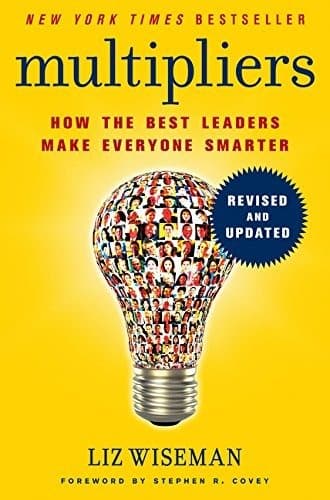
The best leaders make everyone around them smarter — the worst drain intelligence from the room.
The big idea
Wiseman and her co-author Greg McKeown spent two years studying more than 150 executives across four continents to answer a single question: why do some leaders amplify the intelligence of their teams while others diminish it? The research uncovered two distinct types — Multipliers, who use their intelligence to extract and grow capability in others, and Diminishers, who use their intelligence to assert dominance and shut down thinking. Multipliers, on average, get twice the productive capacity from the same people. The book identifies five disciplines that separate the two: Talent Magnet vs.
Multipliers extract twice the capability from the same people — and the math is repeatable.
Liz Wiseman spent seventeen years running Oracle's corporate university before leaving in 2005 to study a pattern she kept noticing. Some executives walked into a room and the smartest people came alive. Others walked in and the same room went quiet. With Greg McKeown, she designed a study covering more than 150 leaders at companies including Apple, Bloom Energy, Microsoft, and the U.S. Army. They interviewed each leader's direct reports separately and asked how much of their capability they used under that leader.
Talent Magnets attract and grow A-players; Empire Builders hoard them and let them rot.
When Wiseman interviewed engineers at one Silicon Valley company about a senior VP they all wanted to work for, the same phrase kept coming up: she made them better. The VP, whom Wiseman calls Marguerite Hancock in the book, ran a team where every member had been promoted within three years of joining. Engineers fought to transfer in. None ever asked to leave.
Challengers seed hard problems; Know-It-Alls hand out answers and shut down thinking.
Irene Fisher took over an under-resourced community service center at the University of Utah in 1987. She knew almost nothing about the work. Within a decade, the Lowell Bennion Community Service Center had become one of the most-cited models of campus engagement in the country, sending more students into community work than programs at universities ten times its size. When Wiseman asked Fisher how she did it, Fisher's answer was that she had asked questions and refused to answer them.
Investors give it back: ownership lives with the person closest to the work.
Sue Siegel, a longtime executive at Affymetrix and later GE, was promoted into a role overseeing product development for a multimillion-dollar genomics platform. The team had a habit Siegel hated: every escalated decision came back to her desk, and she made it. She was solving the same five categories of problem fifty times a year. So she stopped.
The Accidental Diminisher: good intentions, bad effect — the trap that catches the well-meaning.
After the first edition of Multipliers came out in 2010, Wiseman began getting an unexpected email pattern. Senior leaders would write to say they recognized themselves in the Diminisher chapters — but they had never intended to diminish anyone. They were enthusiastic, fast, generous with ideas, and willing to dive in to help. They were also, somehow, the bottleneck. Wiseman ran a follow-up study and identified the pattern she calls the Accidental Diminisher.
The takeaway
Wiseman's gift is a number that reframes management entirely: under Multipliers, employees report using 95% of their intelligence; under Diminishers, the same people use 48%. The leader's job isn't to be the smartest in the room but to make the smartest people in the room come alive — through Extreme Questions, ownership returned, and credit named publicly. You leave watching for the Accidental Diminisher in yourself — the Idea Guy, the Rescuer, the Pacesetter — and asking the only diagnostic that matters: are people leaving my meetings smarter or smaller?