Never Split the Difference
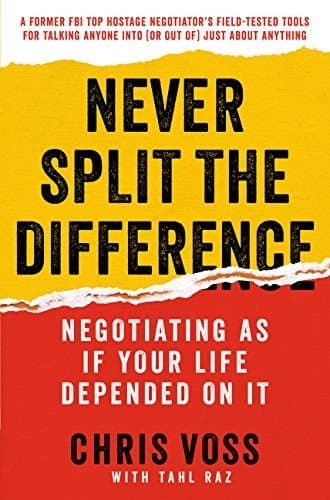
Negotiation lessons from a former FBI hostage negotiator.
The big idea
Voss spent decades negotiating with kidnappers and bank robbers, then translated those tools into business and everyday life. The core insight: negotiation is emotional, not rational. Tactical empathy — labeling emotions, mirroring, calibrated questions — outperforms logical arguments. He's openly skeptical of 'win-win' as a goal; better to let the other side feel they're in control while you steer toward your outcome.
Mirror: repeat the last 1–3 words your counterpart said. It invites elaboration.
On a sweltering June afternoon in 1998, FBI agent Chris Voss stood outside a Brooklyn bank where three robbers had taken hostages and were holding a phone. Voss had no script. His training officer told him to mirror — repeat the last few words the lead robber, Chris Watts, said. 'You're going to kill her at sundown?' 'At sundown?' Voss kept it up for hours. Watts kept filling in details, contradicting himself, talking himself toward exhaustion.
Label emotions: 'It seems like…' acknowledges feelings and defuses them.
Voss recounts a 1993 bank robbery standoff in Chase Manhattan where the robber, holed up with hostages for hours, was eventually talked out by a single sentence: 'It seems like you don't want to go back to prison.' The robber went silent for fifteen seconds, then began describing his life in soft, exhausted tones. Within an hour he surrendered. Naming a feeling reduced its intensity enough to let speech resume on a different register.
'No' is the start of negotiation, not the end — it makes people feel safe.
Voss tells of negotiating his daughter's bedtime by asking 'do you want to keep arguing with me, or do you want to read your book?' Both options nominally allowed her to say 'no' to the previous demand. She chose the book. Yes-questions feel like traps and trigger defensiveness; no-questions feel like safety because they restore the felt autonomy that yes implicitly threatens.
Calibrated questions ('How am I supposed to do that?') shift the burden without confrontation.
Voss tells of his son's high-school football coach demanding a $3,000 contribution Voss couldn't afford. Instead of refusing, he asked: 'How am I supposed to do that?' The coach was forced to think through the problem from Voss's side. By the end of the conversation, the coach had negotiated his own contribution down — Voss never made a counteroffer. The question did the work.
Get to 'that's right' — not 'you're right.' The first means agreement; the second means dismissal.
Voss describes a corporate negotiation where a Fortune 500 client was stuck on a hardline position. Voss summarized the CEO's concerns so precisely — citing fears the CEO hadn't even named — that the CEO leaned back and said two words: 'That's right.' Within twenty minutes, the deal closed at terms favoring Voss's client. Voss had said almost nothing about his own position.
Listen for the black swan — the unknown unknown that flips the negotiation.
Voss describes the 2004 kidnapping of American journalist Jill Carroll in Iraq. The breakthrough came when his team noticed the kidnappers kept mentioning a particular family name in side conversations. That single dropped detail — a relative recently killed by U.S. forces — reshaped the entire negotiation strategy. Carroll was eventually released in March 2006, after 82 days, alive.
Never split the difference — meeting in the middle on prices is a failure of imagination.
Voss's signature illustration: a woman wants to buy $100 shoes; her husband wants to spend $0. They split at $50 — wife gets shoes she half-likes, husband pays for shoes he doesn't want. Both lose. Better to keep negotiating until you find a creative path (returns, alternatives, payment terms) where both sides win. Compromise is often laziness in expensive disguise.
The takeaway
Voss's gift is proving that high-stakes negotiation runs on emotion, not logic — and that tactical empathy beats clever arguments every time. After hearing how mirroring the words of a Brooklyn bank robber for six hours produced a peaceful surrender, and how 'how am I supposed to do that?' beat any counteroffer, you stop preparing rebuttals and start preparing labels. You leave asking calibrated questions instead of making demands, hunting for 'that's right' instead of 'you're right.'