Pre-Suasion
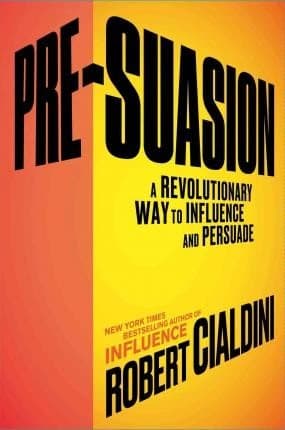
What you do before you make a request matters more than the request itself.
The big idea
Cialdini's follow-up to Influence focuses on the moments before persuasion — what he calls the privileged moment. Direct attention to a concept (security, accuracy, openness) and the requests that follow are more likely to be accepted. The book covers anchoring questions, environmental cues, and the careful use of 'unity' as a seventh principle of influence — shared identity bridges that Cialdini argues are stronger than mere similarity.
What you focus a person's attention on right before a request shapes their response.
Cialdini opens by recounting his three-year undercover stint training in salesforces — used cars, vacuum cleaners, fundraising. He'd expected to learn what top closers said in their pitches. Instead he kept noticing what they did beforehand. The single best closer he watched at a Chicago dealership spent more energy on the pre-frame than on the close itself. By the time the price came up, the customer had already been steered.
Open with the right question and the conversation tilts in your direction.
San Bernardino researcher Daniel Howard ran a phone-survey experiment in 1990 that became a Cialdini staple. Cold-calling for the Hunger Relief Committee, the standard pitch produced 18% donation rates. The same pitch preceded by 'How are you feeling this evening?' — and waiting for the polite 'fine, thanks' — jumped to 32%. Almost everyone who'd just affirmed they were 'fine' found it harder to refuse the request that followed.
Unity — shared identity — outperforms liking as a persuasion lever.
Cialdini distinguishes liking ('we have things in common') from unity ('we are of the same') — the second is far stronger. He profiles a fundraiser at a small Pennsylvania liberal arts college whose cold calls succeeded at twice the rate when she opened with 'I'm calling alumni who, like you, attended X College.' Same script, same ask, same alma mater data — but framing the call as member-to-member rather than stranger-to-alumnus flipped the response rate.
Anchors: the first number, image, or word frames everything that follows.
Cialdini cites a Northwestern University experiment by Adam Galinsky. Customers shown a $7,000 sofa first rated a $4,000 sofa as 'reasonable.' A control group shown the $4,000 sofa first rated it as 'expensive.' The price didn't change; the order of presentation did. Galinsky's published data shows the first number anchors all subsequent numerical judgments — and the effect is strongest precisely when subjects are most certain they're ignoring it.
Specifics beat generalities — concrete language is more persuasive.
University of Oregon decision researcher Paul Slovic ran a charity study testing donations across three conditions. Group A learned about Rokia, a seven-year-old Malian girl facing starvation. Group B saw statistics about millions of children suffering identical conditions. Group C saw both — Rokia plus the statistics. Donations went: A high, B low, C low. Adding the statistical context to Rokia's story actually reduced giving. Generality numbed the specific empathy.
Environment is a quiet persuader — what's on the wall matters.
French researcher Nicolas Guéguen ran a wine-shop experiment in 1999 that Cialdini cites repeatedly. The shop alternated French versus German background music on rotating days, never advertising the change. On French-music days, French wine sales jumped to 77% of total wine purchases. On German-music days, German wine sales rose to 73%. Customers asked at the register reported they'd chosen the wine entirely on its merits and the music had played no role.
Ethical persuasion is sustainable; manipulation poisons the well.
Cialdini closes with the case of Volkswagen's emissions-cheating scandal that broke in September 2015. VW had pre-suaded a generation of consumers around 'clean diesel' — environmental priming followed by performance promises. The EPA discovered the cars contained software detecting emissions tests and switching to a low-pollution mode only during testing. VW's market cap dropped by a third within days; total settlements eventually exceeded $30 billion.
The takeaway
Cialdini's second gift is teaching you that the moment before the ask is more decisive than the ask itself. The fluffy-cloud versus penny-background website, the 'are you adventurous?' opener, the wine-shop's French music quietly steering 77% of purchases — each shows that attention, once directed, drags judgment with it. You leave auditing the room before the conversation, because the privileged moment is doing persuasion's work whether you've designed it or not.