Predictably Irrational
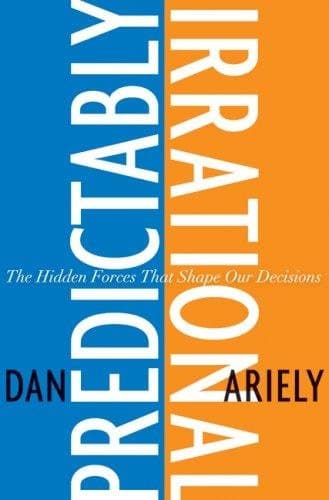
We like to think we weigh choices rationally — but our mistakes aren't random accidents; they repeat in patterns regular enough to predict.
The big idea
Dan Ariely, a behavioral economist who taught at MIT and Duke, spent years running playful, rigorous experiments on real people — students, shoppers, professionals — and kept finding the same thing: human beings deviate from rational decision-making in systematic, repeatable ways. Standard economics assumes we know what we want and choose accordingly; Ariely shows we mostly don't have an internal value meter at all, so we lean on comparisons, anchors, free offers, and price tags to tell us what things are worth.
Relativity rules us: we judge value by comparison, not in absolute terms.
Ariely was browsing The Economist's website when an offer stopped him. Web-only subscription: $59. Print-only: $125. Print-and-web: also $125. The middle option seemed absurd — who would pay the same for print alone as for print plus the website? He suspected it wasn't a typo but a lure, so he printed the three choices and handed them to 100 students at MIT's Sloan School of Management.
FREE! is its own force: zero isn't just a low price, it's an emotional trigger.
Ariely set up a candy table and offered two chocolates: a fancy Lindt truffle for 15 cents and an ordinary Hershey's Kiss for 1 cent. Given that spread, about 73 percent of people reached for the higher-quality truffle, treating it as the better deal.
Money poisons favors: social norms and market norms don't mix.
We live in two worlds, Ariely says. One runs on social norms — helping a friend move, sharing a meal, doing a kindness with no price attached. The other runs on market norms — wages, rents, interest, prices. Trouble starts when the two collide. The AARP once asked a group of lawyers whether they'd offer discounted legal help to needy retirees at about $30 an hour. The lawyers declined.
Expectations become experience: what we anticipate changes what we feel.
Ariely sold students SoBe Adrenaline Rush, an energy drink supposedly sharpening the mind. Some paid the full $1.89; others got it at a discount of about 89 cents. Then everyone tried to solve a set of word puzzles. The students who paid full price solved more puzzles and rated the drink as more effective. The discount drinkers, expecting a weaker boost, got exactly that.
We overvalue what we own: holding something inflates its worth.
At Duke University, basketball tickets are so scarce that getting one is a ritual. Students pitch tents for weeks in a campsite known as Krzyzewskiville, then endure a final lottery that decides who actually receives a ticket. Everyone in line has paid the same price in cold nights and lost sleep — only luck separates the winners from the losers.
The takeaway
Ariely's gift is reframing 'irrational' as a feature of being human rather than a personal failing — the mistakes are systematic, so they can be anticipated. Once you can name the forces pulling at a decision — the decoy, the word free, the price tag, the pull of what you already hold — you can pause long enough to ask what you actually want, instead of what the situation is nudging you toward.