So Good They Can't Ignore You
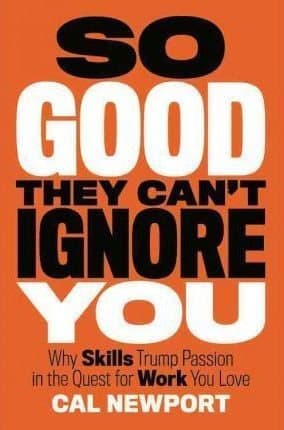
Don't follow your passion — build skills so rare and valuable the world can't ignore you, and passion follows.
The big idea
Newport dismantles the most repeated career advice of the modern age: follow your passion. He argues the passion hypothesis is not only wrong but dangerous, because most people have no pre-existing passion to follow, and the ones who love their work usually grew that love only after becoming excellent. In its place he offers four rules built on a single principle — working right trumps finding the right work. The engine is the craftsman mindset: focus relentlessly on what you can offer the world, accumulating rare and valuable skills he calls career capital.
Follow your passion is dangerous advice: most people have no passion to find.
In June 2005, Steve Jobs stood before Stanford's graduating class and delivered the line that would launch a million motivational posters: you've got to find what you love. Newport opens the book by puzzling over this very speech. If anyone embodied passion-fueled success, surely it was Jobs — and yet the actual record of his early twenties tells a stranger story.
Adopt the craftsman mindset: ask what you can offer the world, not what it owes you.
Newport visits Jordan Tice, a young bluegrass guitarist, and watches him practice. What strikes him is not joy or inspiration but ruthless concentration — Tice deliberately seeking out the passages that expose his weaknesses, slowing them down, repeating them past the point of comfort. He treats the guitar the way a craftsman treats a workpiece: as raw material to be improved, regardless of how he happens to feel that morning.
Career capital is the currency: build rare and valuable skills, then trade them for great work.
The title of the book comes from a piece of advice the comedian Steve Martin gave again and again to young performers who asked him how to make it. In his memoir Born Standing Up, Martin describes the decade he spent grinding through small clubs, methodically reworking his act night after night until it became something no one had seen before. There were no shortcuts and no agents who could substitute for the work.
Control without capital backfires — earn the leverage before you spend it.
Control over how you spend your day is, Newport argues, one of the most powerful traits you can win with career capital. But he warns of two traps. The first ensnares people who reach for control before they have anything to back it up — quitting a stable job to chase a freedom they haven't yet earned the right to sustain. He tells of people who fled corporate careers for passion-driven lifestyle businesses only to find themselves scrambling, because enthusiasm alone is not something the market pays for.
A mission lives in the adjacent possible — reachable only from the cutting edge.
Newport's final layer is mission — a unifying purpose that organizes a working life. His model is Pardis Sabeti, a computational geneticist at Harvard and the Broad Institute who hunts for genetic signatures of recent human evolution, including resistance to diseases like malaria. Her mission feels almost destined. But Newport points out that Sabeti did not begin with it; she stumbled into the focus only after years of mastering the cutting-edge computational tools that made such questions answerable at all.
The takeaway
Newport's gift is permission to stop the exhausting search for a pre-existing passion and start building one instead. Working right trumps finding the right work: when you adopt the craftsman mindset and accumulate rare, valuable skills, you earn the career capital that can be traded for the control and mission that actually make work feel like a calling. The phrase you carry out is Steve Martin's — be so good they can't ignore you — because excellence, not enthusiasm, is what the world reliably rewards.