The 4-Hour Workweek
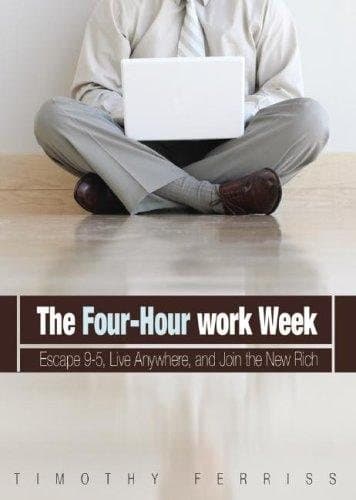
Question the default settings — the 9-to-5-until-65 deal isn't the only one.
The big idea
Ferriss reframes life around 'lifestyle design' instead of deferred retirement. The DEAL framework — Definition, Elimination, Automation, Liberation — challenges readers to define ideal lifestyle, ruthlessly eliminate low-value activity, automate income streams, and untether work from a fixed location. Some tactics have aged (cold-call outsourcing); the underlying mindset shift — that time and mobility matter more than money — has not.
The 80/20 rule applied to everything: which 20% of inputs produce 80% of value?
In 2003, Tim Ferriss was running BrainQUICKEN, a sports-nutrition company he had built while working 80-hour weeks. One Saturday afternoon he sat down with his customer database and applied the Pareto principle for the first time. He found that 5 of 120 customers generated 95% of his revenue. Roughly 80% of his time was being absorbed by the bottom 80%, who collectively generated almost nothing. The math had been there for years; he had never asked the question.
Define your dream lifestyle in concrete numbers, then reverse-engineer the cost.
Ferriss devised an exercise he calls 'dreamlining' for readers paralyzed by the deferred-life plan: list six dream things you want to have, be, and do in 6 months and again in 12 months, then put a real dollar figure on each. Most are far cheaper than people assume — a year traveling South America may cost less than a year of suburban commuting once rent, restaurants, and the daily Starbucks are netted out.
Eliminate before you optimize — being efficient at unimportant work is worse than useless.
Ferriss opens this section with Peter Drucker's most underrated line and the productivity gospel of the entire book. The line cuts across an entire industry of time-management advice, much of which optimizes the wrong work. Eliminationists ask whether the task should exist at all before they ask how to do it faster. Most tasks fail the first question, which makes the second question moot.
Batch tasks (email, errands, meetings) to recover hours lost to context switching.
A widely-cited Carnegie Mellon study found that interrupted workers needed an average of 25 minutes to fully refocus on their original task, and productivity dropped roughly 40% across a day of frequent task switches. Ferriss applied the finding before he had read the study: checking email twice daily and using an autoresponder template that spelled out the schedule, included an emergency phone number, and explicitly invited senders to expect a Tuesday or Thursday reply.
Mini-retirements distributed throughout life beat one long retirement at the end.
In 2004, Ferriss closed his laptop on a Friday afternoon in San Francisco, boarded a flight to Buenos Aires, and stayed there for six months. He took daily Argentine tango lessons and ended the year as a finalist at the Mundial de Tango. His remote business — a few thousand dollars a month from automated systems he had built earlier — paid for the entire stay. He then continued to Berlin, Tokyo, and other cities while the business kept running.
Information diet: most news is noise; cut sources that don't change behavior.
Ferriss recommends a one-week 'low-information diet' as the entry exercise: no news, no magazines, no podcasts that aren't directly tied to a current decision. He found nothing important fell through the cracks — friends and colleagues filled him in on anything truly relevant. Most consumed information, he discovered, is entertainment masquerading as preparation.
Don't ask permission, ask forgiveness — it's faster and the consequences are usually mild.
Ferriss tells of asking his then-employer for permission to work remotely two days a week. Denied flatly. He simply started doing it the following Monday, performed measurably better than the office benchmark for the next quarter, and was eventually given a raise. The 'permission' he had been denied turned out to be permission for the conversation, not permission for the behavior; the behavior, once happening, was easier to accept than to undo.
The takeaway
Ferriss's gift is the permission slip to question the deferred-life plan — the assumption that you trade your forty best years for a vague retirement number nobody priced. Run the 80/20 cut, eliminate before optimizing, batch what's left, and most of what felt like obligation was inherited rather than chosen. You leave dreamlining the actual cost of the life you want and asking forgiveness instead of permission for the next move.