The Alchemist
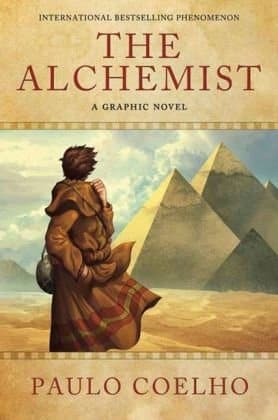
A fable about following your dream — and how the universe quietly conspires when you do.
The big idea
A young Andalusian shepherd named Santiago dreams of treasure at the Egyptian pyramids and sets out to find it. Along the way he meets a king, a thief, an Englishman searching for the philosopher's stone, and an alchemist who teaches him the language of the world. The book's premise is simple: pursuing your Personal Legend — your deepest calling — is the one thing that gives life meaning, and the universe rearranges itself to help.
When you want something, all the universe conspires in helping you achieve it.
Paulo Coelho wrote The Alchemist in 1987 in two weeks, in Portuguese, after walking the Camino de Santiago pilgrimage the year before. The novel's first publisher in Brazil sold under a thousand copies and dropped it. A second publisher took it on, and within five years it had begun the slow climb that would eventually make it the most translated book by a living author.
The fear of suffering is worse than the suffering itself.
When Santiago is robbed in Tangier his entire savings vanish in an afternoon. He's stranded with no money, no Arabic, no plan. He discovers the imagined catastrophe was worse than the actual one — he ends up working at a crystal merchant's shop and learning more about commerce, Arabic, and patience than he could have planned. The robbery turns out to be tuition.
Most people give up on their dreams when they're closest to fulfilling them.
The crystal merchant tells Santiago that he's wanted to make the pilgrimage to Mecca his whole life — but he's afraid that once he goes, he'll have no reason to live. The dream becomes more comfortable than its fulfillment, so he keeps it on a shelf forever. The unvisited Mecca preserves the merchant's identity as someone-who-is-going-someday.
Listen to your heart — it knows what it wants because it came from the Soul of the World.
The alchemist tells Santiago his heart will be afraid, will lie, and will sometimes not want to keep going — but he must listen anyway, because hearts always tell us what we need to hear, even when we don't like it. The heart's grammar is omens, gut tightenings, recurring images. The rational mind dismisses each as coincidence. The omens accumulate anyway.
There is only one way to learn — through action.
Santiago meets an Englishman searching for the philosopher's stone, who has been studying alchemy from books for ten years and never made gold. Santiago, in months of desert travel, learns to read the wind and listen to the universe directly. Coelho's distinction: the Englishman wants to understand the world; the alchemist's path requires meeting it.
The treasure is often in your own backyard, but you have to leave to recognize it.
Santiago travels from Spain across North Africa to the Pyramids only to discover the treasure was buried back in the ruined church where his journey began. He digs at the sycamore where he had his original dream and finds the gold. The book's final twist: the destination existed at the start. Only the eyes to see it had to be earned.
Every search begins with beginner's luck and ends with the test of the conqueror.
Coelho's pattern: Santiago's first foray rewards him quickly — selling sheep, meeting the king, finding directions. Then reality tests him: robbery in Tangier, a year working at the merchant's shop, desert dangers, the alchemist's trials. The early luck exists to plant the dream. The later trials exist to confirm whether you really want it.
The takeaway
Coelho's gift is reframing risk as the price of admission to your own life. Once you accept that the fear of suffering outweighs suffering itself, and that the four obstacles to a Personal Legend live inside you rather than the desert, the journey becomes the alchemy you mistook for the gold. You leave less interested in arriving at the Pyramids and more interested in noticing the omens already on your street.