The Almanack of Naval Ravikant
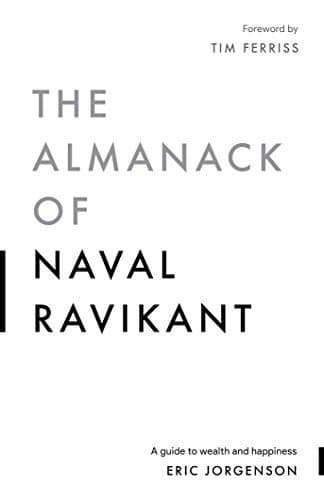
Wealth is what earns while you sleep — a latchkey immigrant kid turned that one idea into a philosophy of freedom.
The big idea
Eric Jorgenson assembled this book from a decade of Naval Ravikant's tweets, podcasts, and essays, distilling the AngelList founder's thinking into two halves: how to build wealth and how to be happy. The wealth half is ruthless about mechanics — seek assets that earn while you sleep, not money or status; stop renting out your time; arm yourself with specific knowledge, accountability, and leverage. Naval's signature move is separating the three kinds of leverage — labor, capital, and the new permissionless leverage of code and media that works while you sleep.
Seek wealth, not money or status: only assets that earn while you sleep buy real freedom.
Naval Ravikant was born in Delhi in 1974 and immigrated to New York at nine, landing in Queens with his mother and brother. She worked and studied at once, and he became a latchkey kid whose real home was the public library after school. That childhood — watching someone trade every waking hour for money and still fall behind — planted a lifelong obsession with a different question: not how to earn more, but how to never have to sell your time again.
You will not get rich renting out your time: own equity and put leverage to work.
Naval's own path taught this the hard way. He co-founded Epinions in 1999, rode it through the dot-com crash, and watched the company's value nearly vanish before a contested outcome years later. The lesson he took wasn't about any one deal — it was structural: people paid by the hour, even highly paid ones, have their income capped by the clock. The people who become wealthy own a piece of something that keeps producing when they step away.
Arm yourself with specific knowledge, accountability, and leverage — none of it taught in school.
Naval attended Stuyvesant, one of New York's elite public high schools, and then Dartmouth for economics and computer science — and still insists the most valuable skills he has were never on any syllabus. Formal education, he argues, is designed to produce interchangeable people. The knowledge that makes you irreplaceable is precisely the kind no institution can hand out on a certificate.
Play long-term games with long-term people: every real return is compound interest.
Naval frames business the way a physicist frames orbits — as a system dominated by compounding. In tech circles it's an axiom that the venture and the relationships around it pay off not from any single transaction but from decades of repeated, honest dealing. Reputation, in his telling, is the highest-yielding asset most people never think to invest in.
Happiness is a skill you develop — and desire is a contract to stay unhappy until you get what you want.
The book's second half turns from the outer game of money to the inner game of peace — and here Naval speaks as someone who reached financial freedom and discovered it did not automatically deliver contentment. He describes deliberately dismantling his own wanting, treating each craving as a self-imposed sentence rather than a path to satisfaction.
The takeaway
Naval's gift is a single mental split: master the outer game of freedom by owning equity and leverage, then master the inner game of peace by dismantling desire. Wealth buys you the option to stop selling your time; happiness is the separate skill of no longer needing anything more. Build both, and you own your days.