The Checklist Manifesto
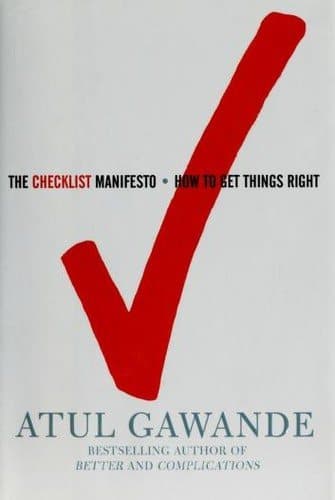
The reason experts fail is rarely ignorance — it's that the volume of what we know has outgrown any one person's ability to deliver it reliably.
The big idea
Gawande, a surgeon at Brigham and Women's Hospital, starts from an uncomfortable observation: in medicine, aviation, engineering, and finance, the knowledge required to do the job correctly now exceeds what any individual expert can hold in mind under pressure. Borrowing philosophers Samuel Gorovitz and Alasdair MacIntyre's distinction, he separates failures of ignorance — we don't know enough — from failures of ineptitude, where we know exactly what to do and fail to do it.
The modern failure mode is ineptitude, not ignorance: we know what to do and fail to do it.
On October 30, 1935, at Wright Field in Dayton, Ohio, the U.S. Army Air Corps gathered to watch a flight competition. Boeing's Model 299 was the presumed winner — sleeker, faster, and capable of carrying five times the bombs the Army had requested. Major Ployer P. Hill, the Air Corps' chief of flight testing, took the controls. The plane climbed to three hundred feet, stalled, banked, and crashed, killing Hill and one other crewman. The investigation found no mechanical fault. Hill had simply forgotten to release a lock on the elevator and rudder controls. A newspaper called the Model 299 'too much airplane for one man to fly.'
Pronovost's five-step line checklist drove a state's infection rate to zero — by enforcing what everyone already knew.
In 2001, Peter Pronovost, a critical care specialist at Johns Hopkins Hospital, wrote down the steps for inserting a central venous line: wash hands with soap; clean the patient's skin with chlorhexidine antiseptic; drape the entire patient in sterile cloths; wear a sterile mask, hat, gown, and gloves; place a sterile dressing over the insertion site once the line is in. Five steps, all of them long-established, none of them controversial. He then asked the nurses in his ICU to observe for a month and record how often doctors completed them.
Most checklists fail: the good ones are short, tested, and only list the steps experts actually skip.
Gawande flew to Seattle to meet Daniel Boorman, a Boeing veteran who had spent two decades building the checklists that go into the cockpit of every commercial aircraft the company makes. Boorman's craft has hard rules. A checklist runs sixty to ninety seconds. It holds roughly five to nine items, the outer edge of working memory. It names a precise pause point at which it must be used. And it contains only the killer items — the steps that are both critical and, in the accident record, actually skipped by trained professionals.
Complexity defeats the master builder: push authority to the periphery and force people to talk.
Curious why skyscrapers almost never collapse, Gawande visited a hospital building under construction in Boston with Joe Salvia, the structural engineer whose firm had done the work, and Finn O'Sullivan, the project executive. Buildings are staggeringly complex — hundreds of trades, thousands of components, no single person who understands all of it — yet serious structural failures in the United States run to only a handful a year across millions of buildings. Gawande expected to find a master builder. He found two spreadsheets instead.
The evidence is overwhelming and the resistance is total — because using a checklist feels beneath us.
In 2006 the World Health Organization asked Gawande to lead a program to reduce deaths in surgery. His team built a nineteen-item checklist and tested it in eight hospitals on four continents, deliberately chosen for their range: Toronto, Auckland, London, Seattle, Amman, New Delhi, Manila, and a rural district hospital in Ifakara, Tanzania, where the operating theater had no reliable oxygen supply.
The takeaway
Gawande's gift is stripping the glamour out of competence. Once you accept that expertise now fails from ineptitude rather than ignorance — that Major Hill was the best pilot in the Army and still forgot the elevator lock — the question stops being how do I know more and becomes what would make me reliably do what I already know. You leave less interested in being the master builder and more interested in the index card that makes the master builder unnecessary.