The Four Agreements
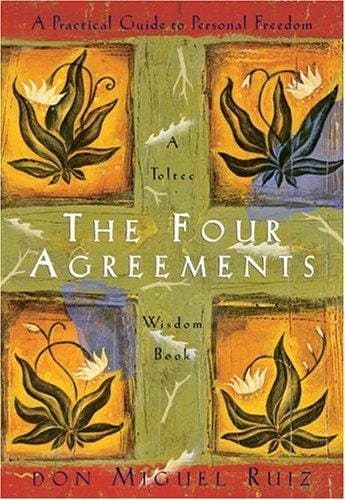
Four ancient Toltec agreements that quietly run modern lives well.
The big idea
Ruiz draws on Toltec wisdom to offer four simple but exacting rules for personal freedom: be impeccable with your word, don't take anything personally, don't make assumptions, always do your best. They sound trivial; living any one of them for a week reveals how much of daily suffering comes from breaking them. The book reads as a slim wisdom manual rather than a tactical handbook.
Be impeccable with your word — speak with integrity; words create reality.
Don Miguel Ruiz was a Mexican surgeon trained in Mexico City who survived a near-fatal car accident in his late twenties. The experience pulled him out of medicine and into the Toltec lineage of his mother, the curandera Sarita, where he eventually became a nagual — a teacher in the tradition. The Four Agreements distills that lineage into four sentences.
Don't take anything personally — what others do is about them, not you.
Ruiz argues that nothing other people do is because of you — it's because of themselves and the dream they're living in. He gives the example of being in a coffee shop and overhearing someone shout 'You're stupid!' If you hadn't been listening, it wouldn't have hurt. You only catch the arrow because you're standing in the way of someone else's projection.
Don't make assumptions — ask, clarify, and check before reacting.
Ruiz sees assumptions as the source of most relational fights. We invent a story about why our partner was late or quiet, mistake the story for reality, and react to the fiction. The cure is courage — the courage to ask 'what did you mean by that?' rather than spend a week stewing in an imagined slight.
Always do your best — your best varies by day; the discipline is consistency.
Ruiz adds an important caveat to this agreement: your best changes from moment to moment. Sick versus healthy, exhausted versus rested, grieving versus content — your best on each is different. The agreement isn't about a constant peak; it's about not under-delivering relative to what's actually available today.
Most personal hell comes from agreements we made unconsciously in childhood.
Ruiz's framing: from birth, we're domesticated — taught what to believe, what's good and bad, who we are — through reward and punishment. Each agreement we accepted shapes our adult Book of Law. Personal freedom requires hunting these agreements, especially the ones that say 'I'm not enough,' and consciously breaking them one at a time.
Self-judgment is the cruelest agreement; awareness loosens its grip.
Ruiz observes that we punish ourselves for the same mistake a thousand times — far harder than any external judge would. The internal Judge and Victim form a loop nobody else maintains. The mistake was paid for once; the mind keeps charging interest on it for thirty years. Once seen clearly, the loop's power weakens.
Practice these four for a year and they remake your relationships.
Ruiz frames the agreements as a path, not a finish line: simple to remember, exacting to live. He claims that consistent practice for even a few months loosens decades of conditioning, because each agreement is a counter-vote against the false ones already in place. The point isn't perfection. It's the directional choice, made daily, that compounds.
The takeaway
Ruiz's gift is naming the unconscious contracts that quietly govern adult suffering. Once you see your inner Judge as a parasite feeding on rehearsed pain rather than the voice of conscience, the question stops being 'how do I do better?' and becomes 'which agreement, broken once today, would starve the loop?' You leave watching your words land in the soft soil of yourself before they reach anyone else.