The Hard Thing About Hard Things
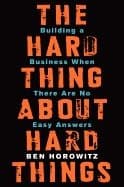
Most leadership books teach the smooth path — Ben Horowitz wrote about the part nobody else admits to: the months when nothing works.
The big idea
In March 2001, Ben Horowitz took Loudcloud public in the worst tech market in decades, raising $162.5 million in an IPO he later called the IPO from hell. Over the next few years he laid off hundreds of employees, sold the cloud-hosting business under emergency conditions, pivoted what remained into a software company called Opsware, and eventually sold it to Hewlett-Packard in 2007 for $1.6 billion. The Hard Thing About Hard Things is the book he says he wished he had during those years — the manual nobody writes because nobody wants to admit they didn't know what they were doing.
The Struggle: the part of the CEO job that nobody puts on the recruiting page.
In March 2001, Ben Horowitz took Loudcloud public in the worst tech market in decades. The Nasdaq had cratered. His underwriters cut the offering price three times in the final week. Customers in his pipeline were going bankrupt faster than his team could sign them. He went through with the IPO anyway because the alternative was running out of cash, raising $162.5 million in what he later called the IPO from hell. He was thirty-four years old.
There are no silver bullets, only lead bullets — fix the product before you fix the story.
By 2003, Opsware — the renamed Loudcloud — was getting beaten in head-to-head sales by a smaller competitor called BladeLogic. Customers liked Opsware's vision but kept choosing BladeLogic's product. Horowitz called a meeting of his executives. The room filled with proposals — a new partnership, a marketing campaign, a strategic acquisition, a repositioning of the product line. Each proposal was elegant. Each one promised to fix the problem without actually fixing the problem.
Wartime CEO vs Peacetime CEO: the same person rarely runs both companies well.
Around the depths of Loudcloud's collapse, Marc Andreessen called Horowitz with a question. Did Horowitz know the difference between a peacetime CEO and a wartime CEO? Horowitz didn't. Andreessen explained that he thought Horowitz had been operating like a peacetime CEO — trying to keep everyone happy, broadening the agenda, encouraging creative input — when the actual conditions called for someone different. The conversation reframed how Horowitz spent his next several years.
Take care of the people, the products, and the profits — in that order, because the order is causal.
Horowitz argues that the strongest competitive moat a company can build is not a technology or a brand but a culture where good people want to stay. He cites his own experience at Loudcloud and Opsware, where in the worst stretch of the layoffs employees were lining up to ask how they could help instead of asking when they could leave. That kind of loyalty did not happen by accident. It had been engineered, deliberately, over years.
If you're going to eat shit, don't nibble — when the call is hard, do it once, deeply.
Over the years at Loudcloud and Opsware, Horowitz had to lay off employees in three separate rounds. Each one was painful in a different way, and by the third he had developed a hard opinion about the wrong way to do it. The wrong way was to soften the cut — to lay off ten percent now, then another five percent next quarter, then another five the quarter after that, hoping each smaller wave would feel kinder than a single large one. The opposite was true.
The takeaway
Horowitz's gift is the chapter you wish your CEO had read. He refuses the genre's reliance on triumphant retrospection — every framework here is anchored in a moment when he chose wrong and lived with the cost. You finish the book with no illusion that the right strategy or the right hire will save you, but with a clearer sense of what surviving the days when nothing works actually requires: do the hard thing fully, tell the truth quickly, and keep showing up tomorrow.