The Magic of Thinking Big
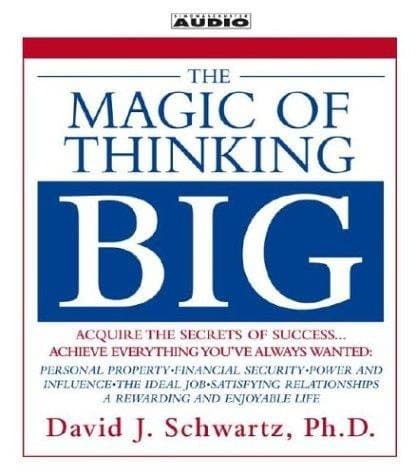
Belief sets ceilings; thinking bigger raises them.
The big idea
Schwartz, a 1950s management researcher, argued that the size of your bank account, leadership, and happiness are all set by the size of your thinking. People underperform not because of capability but because of low belief about what's possible. The book is plain-spoken and built on dozens of practical case studies: how to think and dream creatively, how to stop making excuses, how to act bigger than you currently feel.
Action cures fear — inaction grows it.
David Schwartz wrote The Magic of Thinking Big in 1959 while teaching at Georgia State University, drawing on hundreds of interviews with executives, salespeople, and dropouts across the postwar boom. He'd noticed the same pattern among the dropouts: they had usually waited too long before their first attempt, and the waiting had calcified into paralysis.
Believe it can be done — the mind finds ways to make a believed thing real.
Schwartz tells of a salesman told his territory was impossible — and produces nothing. The territory is reassigned to a new salesman told it was the firm's most promising — and he hits records. The territory is identical; only the belief differed. Schwartz calls disbelief negative power that summons the very evidence to confirm itself.
Think bigger about everything you do; small thinking is a self-fulfilling prophecy.
Schwartz catalogues the language of small thinkers: 'I'm just a teacher,' 'It's only a clerk's job,' 'It can't be done in this town.' The size of the thinker shrinks to fit the language. Vocabulary isn't decoration — it's the operating system. Whatever you call yourself, the brain spends years arranging proof.
Your environment shapes you — choose people who think big, avoid chronic small-thinkers.
Schwartz prescribes auditing your inner circle: who lifts the ceiling on what's possible, who lowers it? Spend more time with the first group — their conversation alone enlarges your reference of what's achievable. Avoid the chronic complainer not because of moral judgment but because their ceiling becomes yours by osmosis.
Get the action habit — just start, refine while moving.
Schwartz contrasts the activationist (who acts) with the passivationist (who waits for conditions to be perfect). The activationist starts the imperfect first draft, makes the imperfect first call, ships the imperfect first product, and learns from real feedback while the perfectionist is still planning. Speed of starting beats quality of starting nine times out of ten.
Practice adding value: ask, 'How can I do better?', not 'Can I get away with less?'
Schwartz tells of an electrician who, after every job, asks the customer one extra question about other things he might check. He's so over-delivering that he's booked solid for years. The question 'how can I do more, better, faster' organizes the brain toward a different career trajectory than 'how can I get by.'
How you think when you lose determines how long it'll be before you win.
Schwartz tells of a salesman who lost his biggest account and, instead of nursing the wound, called the customer back to ask exactly what he could have done better. He documented the answers and used them to win seven new accounts the same year. Defeat is information until you turn it into identity; treat it as feedback and the next attempt has a better chance.
The takeaway
Schwartz's gift is showing that belief writes itself into behavior before any decision arrives — micro-eye-contact, wait time, vocabulary — and quietly produces the outcomes you call talent. The activationist who starts the imperfect first call beats the passivationist still waiting for conditions, because readiness is a sensation manufactured by movement. You leave catching small phrases like 'I'm just a cashier' as they form, and substituting the bigger one before the brain spends another year arranging proof.