The Obstacle Is the Way
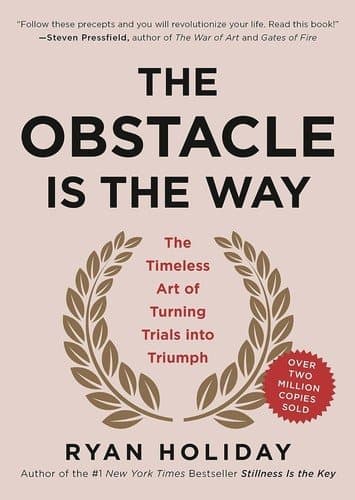
The same Stoic discipline that steadied a Roman emperor and built America's great fortunes turns every setback into raw material — the impediment to action becomes the action itself.
The big idea
Holiday takes a single line from Marcus Aurelius's private journal — that what stands in the way becomes the way — and builds a practical philosophy of resilience around it. He organizes the book into three disciplines the Stoics prized: Perception, the ability to see events clearly and without panic; Action, the energetic, persistent, often creative response; and Will, the internal fortitude to endure what cannot be changed. Rather than argue in the abstract, he tells stories: John D.
Perception is a choice: the obstacle is only as large as the story you tell about it.
Holiday opens with John D. Rockefeller as a sixteen-year-old assistant bookkeeper in Cleveland, earning fifty cents a day. When the Panic of 1857 swept the country and grown men around him lost their fortunes and their nerve, Rockefeller watched coolly. He came to see financial panics not as catastrophes but as recurring weather — predictable, survivable, and full of opportunity for anyone who kept their head while others lost theirs.
The title is a 2,000-year-old instruction: what stands in the way becomes the way.
The book's title comes from a line in the private notebook of Marcus Aurelius, emperor of Rome from 161 to 180 AD. Marcus never intended the notes for publication; they were reminders he wrote to himself, late at night, while ruling an empire through plague, near-constant war on the frontier, and the betrayal of a trusted general. The man with more power than anyone alive used his journal to practice staying disciplined, humble, and undefeated by circumstance.
Action means persistence so relentless it looks like genius.
Demosthenes was born a frail boy in Athens with a debilitating stutter, and when his father died, the guardians entrusted with his inheritance stole nearly all of it. He had every excuse to disappear. Instead he built an underground study and disappeared into it for months at a time — and to keep himself from sneaking out before the work was done, he shaved off half his hair so he would be too embarrassed to be seen in public.
The Will is the discipline of loving what happens to you — amor fati.
In December 1914, much of Thomas Edison's plant in West Orange, New Jersey, caught fire. Years of work and irreplaceable records were going up in flames. According to the story Holiday tells, the sixty-seven-year-old Edison, rather than collapsing, found his son in the crowd and told him to go get his mother and her friends — they would never see a fire like this again in their lives.
Within every obstacle is an opportunity — and the cycle never stops.
By the close of the book, Holiday's three disciplines have become a single loop. Perceive the situation without panic, act on what can be moved, and will yourself through what cannot — and then the next obstacle arrives and you run the loop again. The figures he profiles did not solve adversity once; they built a repeatable way of meeting it, which is why their composure looks almost superhuman from the outside.
The takeaway
Holiday's gift is a usable structure for adversity: see clearly without panic, act on what you can move, and endure what you cannot — then run the loop again on the next obstacle. The recurring lesson, drawn from Marcus Aurelius to Rockefeller to Edison, is that the difference between a setback and a making is almost entirely internal. Practiced as a discipline rather than a mood, the obstacle stops blocking the path and becomes it.