The One Thing
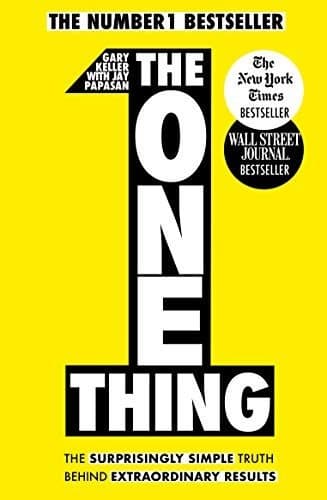
What's the ONE thing such that doing it makes everything else easier or unnecessary?
The big idea
Keller (Keller Williams Realty co-founder) builds a productivity philosophy around a single focusing question, applied at every time horizon: lifetime, year, month, week, day, hour. Multitasking is a lie. Willpower is finite. Discipline is overrated; it's habit you're after. The book pairs the question with time-blocking — putting your One Thing on the calendar before anything else gets a slot.
Ask: 'What's the One Thing I can do, such that by doing it everything else is easier or unnecessary?'
At a 1991 dinner hosted by Bill Gates Sr., the host asked his son Bill Gates and Warren Buffett — independently and on cocktail napkins — to name the single factor most responsible for their success. Both wrote the same word: focus. Gates Sr. kept the napkins. The convergence wasn't coincidence; both men had spent decades practicing the disciplined refusal of nearly everything in pursuit of one thing at a time.
Time-block your One Thing first thing in the morning — protect it from everything else.
Keller built Keller Williams Realty by protecting his mornings so fiercely that staff learned not to schedule meetings before 1 p.m. — even with him, even urgent ones. The block was sacred. He claims the difference between his career and the careers of equally talented founders who were perpetually 'available' is exactly that protected morning, repeated for thirty years.
Multitasking is a myth — it's just rapid switching at heavy cognitive cost.
Keller cites University of California Irvine research by Gloria Mark showing interrupted workers compensate by working faster, but pay with higher stress, frustration, and error rates. He pairs this with research from Stanford's Clifford Nass, who found heavy multitaskers performed worse on every measure of attention and memory than light multitaskers — even on tasks the heavy multitaskers should have excelled at.
Willpower is finite — schedule hard work for when yours is highest.
In a famous 1998 experiment at Case Western Reserve, psychologist Roy Baumeister placed subjects in a room with fresh chocolate-chip cookies and a bowl of radishes. Half were told to eat the cookies; half were told to eat only the radishes. Both groups then attempted an unsolvable puzzle. The radish group gave up in eight minutes; the cookie group worked nineteen. Resisting the cookies had drained their willpower.
Habits, not discipline, sustain results — most habits form in about 66 days.
In 2009, Phillippa Lally at University College London tracked ninety-six volunteers attempting to install habits ranging from drinking water at lunch to running before breakfast. The average time to automaticity was sixty-six days, with a range from eighteen to two hundred fifty-four depending on difficulty. Crucially, missing a single day did not reset the clock.
Big goals require big actions — scaled down, they're just regular goals with extra steps.
Keller recounts a coaching client who set a goal to add ten thousand dollars to her annual income — and treated it as a stretch. Keller asked what action would generate a hundred thousand instead, forcing her to abandon the small move (one extra client per month) for a structural one (changing her business model entirely). She hit the larger number within eighteen months.
Domino effect: knock down one well-chosen tile and a chain falls.
In 1983, physicist Lorne Whitehead published a finding in the American Journal of Physics: a single domino can knock down another up to fifty percent larger than itself. Stacked correctly, a five-centimeter domino can topple something the size of the Empire State Building twenty-nine dominoes later. The energy stored in each falling tile amplifies geometrically into the next collision.
The takeaway
Keller's gift is the focusing question that cascades through every horizon — what's the One Thing such that doing it makes everything else easier or unnecessary? Gates and Buffett wrote the same word on Bill Sr.'s napkins; multitasking is a lie; willpower is finite; the lead domino is usually boring. You leave with a four-hour morning block defended in writing, sixty-six days of patience for one habit at a time, and the geometric payoff waiting at domino twenty-nine.