The Subtle Art of Not Giving a F*ck
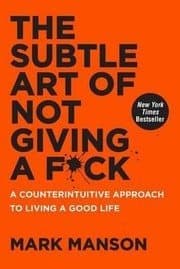
You only have so many fks to give — choose them deliberately.
The big idea
Manson's counter-self-help argues that the modern obsession with positivity is itself the problem: chasing happiness makes us miserable, while accepting struggle and choosing what to care about brings real meaning. Pick your problems carefully, because life is a continuous stream of them. Pain and discomfort aren't failures — they're the price of anything worthwhile. Take responsibility for everything in your life, even what isn't your fault.
Happiness comes from solving good problems, not from problem-free living.
Charles Bukowski spent thirty years drinking, womanizing badly, gambling away his post office paychecks, and writing poetry no one wanted to publish. He received around a thousand rejection slips before his first book sold. By the time he died in 1994, he had published over forty books and was one of the most translated American writers of the twentieth century. His tombstone reads: 'Don't try.'
Choose what to care about; running out of care for trivial things is freedom.
Manson borrows the 'backwards law' from Alan Watts, the British-American philosopher who introduced Buddhism to a generation of postwar Americans. The law states that the more you chase a feeling, the more it eludes. The pursuit of being rich reminds you that you're not. The pursuit of being loved reminds you that you're alone. The pursuit of being confident reminds you that you're not.
Take responsibility for everything that happens to you, even what isn't your fault.
In 1872, the philosopher William James — soon to be the founding figure of American psychology — was so deeply depressed at age thirty that he was contemplating suicide. He found a passage in the work of French philosopher Charles Renouvier on free will and decided to run an experiment: for one year he would act as if every choice he made mattered fully, even though he didn't believe it. The bet rebuilt him. The experiment lasted the rest of his life and produced the foundational works of American psychology.
You're not special — and that's good news, because it lowers the stakes.
On December 24, 1944, Japanese soldier Hiroo Onoda was sent into the Philippine jungle on Lubang Island with orders never to surrender. World War II ended nine months later. Onoda did not surrender. He fought on for twenty-nine years, killing local Filipino farmers he believed were enemy combatants, refusing leaflets, refusing his own brother's voice on a loudspeaker, refusing newspapers dropped from planes. He finally surrendered in 1974 only after his original commanding officer was flown out to personally rescind his orders.
Certainty is the enemy of growth; embrace 'I might be wrong.'
Manson recounts the year his vision of himself as 'a misunderstood writer' was protecting him from doing the actual writing. The identity provided a built-in explanation for every failure (the audience wasn't ready) and a built-in dismissal of every critique (the critics didn't get it). Once he doubted that identity — admitted he might just be writing badly — the writing improved within months. Certainty had been the cage.
Pain is the universe's feedback mechanism — pay attention to what it teaches.
Manson describes a friend whose startup collapse took roughly eighteen months — twelve months of denying the writing on the wall, then one painful month of accepting reality and pivoting, then five months of building something that actually worked. The pain wasn't the failure. The pain was the avoidance of facing the failure. The startup's burn rate during denial was the same regardless of whether the founder admitted what was happening.
Death gives life meaning; remembering you'll die clarifies what matters.
When Manson was in his early twenties, his best friend Josh died in an accidental drowning. The death shattered Manson's adolescent sense of invincibility and started his lifelong inquiry into what to actually do with a ticking clock. The book closes with him standing alone on the cliff at Cape Point, South Africa, staring down at the Atlantic and feeling, for the first time, what he calls liberation through fear.
The takeaway
Manson's gift is permission to stop performing the cult of positivity and instead choose your problems on purpose. Happiness is not the absence of struggle but the presence of struggle worth having, and Bukowski's tombstone — 'don't try' — is not nihilism but release from the desperate striving that poisons most ambition. You leave taking responsibility for your 1% of everything, even what isn't your fault, because that's where agency actually lives.