The Tipping Point
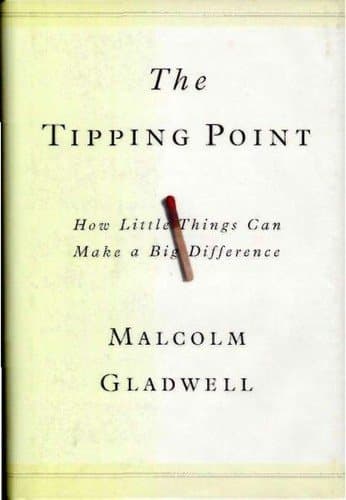
Ideas, products, and behaviors spread like epidemics — under specific conditions.
The big idea
Gladwell argues that change happens in non-linear bursts, governed by three rules: the Law of the Few (a small number of unusually-connected people drive most spread), the Stickiness Factor (the message has to be memorable in a specific way), and the Power of Context (small environmental changes massively shift behavior). The book pairs research with case studies — Hush Puppies, NYC crime decline, Sesame Street — to show how big change comes from small, well-targeted nudges.
Connectors, mavens, and salesmen drive most word-of-mouth spread.
In late 1994, Hush Puppies — the brushed-suede shoes — were nearly dead. Sales had collapsed to thirty thousand pairs a year, and the parent company was preparing to phase the brand out. Then, almost without anyone noticing, a few East Village club kids in Manhattan started wearing them ironically. By 1996, the company sold 1.7 million pairs.
Small changes in stickiness — a phone number, a slogan — can multiply uptake.
In the 1960s, a Yale public health team ran an experiment on tetanus shot uptake among students. Lectures alone — even powerful ones using fear appeals — moved compliance to a paltry three percent. Then they added a campus map with the clinic circled and a list of available appointment times. Compliance jumped to twenty-eight percent. The information was identical; the small change in stickiness multiplied behavior change ninefold.
Context matters more than character — broken windows changes behavior more than lectures.
In 1990, New York City logged 2,245 murders — the highest total in its history. By 2003, the number had dropped to 596. The strategy associated with the decline was William Bratton's broken-windows policing in the subway: clean every graffitied car overnight, prosecute every turnstile jumper, and refuse to let any tagged train return to service. Felony arrests in the subway dropped over seventy-five percent within years.
The 150 rule (Dunbar): groups beyond ~150 lose tight-knit dynamics.
Bill Gore, founder of W.L. Gore — the company that makes Gore-Tex — instituted a peculiar manufacturing rule. Whenever a factory's headcount reached 150, he'd build a new one. The reason wasn't economic. At 151, Gore had observed, employees stopped being able to track who everyone was, social pressure weakened, and bureaucracy had to be added. Gore had never heard of Robin Dunbar; he had simply noticed the pattern.
Epidemics are driven by exceptional people in exceptional positions, not averages.
On the night of April 18, 1775, two Boston Patriots set out on identical missions to warn the countryside that British troops were marching on Concord. Paul Revere rode north through Charlestown to Lexington. William Dawes rode west through Roxbury and Brookline. By morning, Revere's path had ignited militias in town after town; Dawes's identical-distance route through equally Patriot towns produced almost nothing.
Test for stickiness empirically — most assumptions about what'll resonate are wrong.
Joan Ganz Cooney's Children's Television Workshop, the team behind Sesame Street, ran what was for the era an unusual research protocol. They would coax children into a viewing room, place a slide projector showing rotating images beside the TV, and time-stamp every glance away from the show. If a kid looked at the slides instead of Big Bird, the segment had failed.
Tip the right small things and big change becomes possible without big budgets.
In the 1990s, Baltimore experienced a sudden syphilis outbreak that exploded only because three small environmental shifts coincided: a public health agency cut clinic hours, crack arrived in specific neighborhoods, and public housing demolitions scattered carriers across new networks. None alone would have tipped it; together they crossed the threshold. Thousands of cases resulted from three quiet bureaucratic decisions.
The takeaway
Gladwell's gift is showing you that big change rarely comes from big effort — it comes from finding the lever, not lifting the boulder. Once you've watched Hush Puppies revive itself through East Village Connectors and NYC crime collapse via clean subway cars, you stop asking 'how do we throw more at this?' and start hunting for the small, well-targeted nudge. You leave looking at every stuck problem as a system one Connector, one sticky message, or one context shift away from tipping.