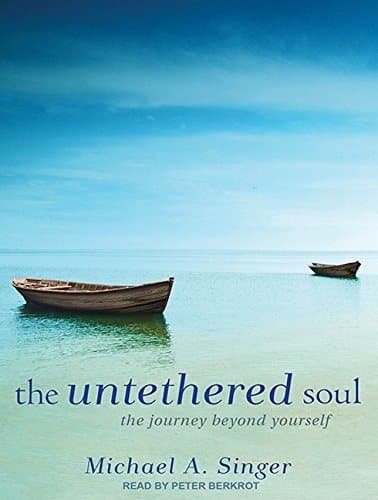
The Untethered Soul
Watch the inner narrator and you'll discover you're not it.
The big idea
Singer guides readers into the position of the witness — the awareness behind the constant inner monologue. The mind talks endlessly because we use it to maintain a fragile model of how things should be. Letting go of that protection — relaxing in the heart, releasing energy as it arises — opens a different way of being: present, unguarded, and free. The book is gentle, contemplative, and practical.
You are not the voice in your head — you're the one who hears it.
In 1971, Michael Singer was 24, finishing his master's in economics at the University of Florida. He was sitting alone one afternoon when he became suddenly aware of a continuous voice in his head — narrating, judging, second-guessing. He asked the question that opened the next 40 years of his life: who is talking? And just as importantly: who is listening?
The heart is a constant flow of energy; suffering comes from blocking it.
Singer describes the heart as a pump for spiritual energy — what yogis call shakti, what others call chi. When you cling to a moment ('I want this feeling forever') or push one away ('I never want to feel this again'), you constrict the flow and store the blockage. The Sanskrit word for the stored compression is samskara.
Relax and release — instead of clenching around discomfort, soften and let it pass.
Singer's primary instruction: when something disturbs you — a comment, a memory, a fear — notice the tightening in the chest and consciously relax behind it. Don't fight it, don't analyze it; soften, breathe, let it pass through. He calls this leaning back, as if reclining in a chair while the disturbance moves through the room without you grabbing it.
Don't protect the personal self at all costs; that's what creates most pain.
Singer points out that we build elaborate defenses around 'me' — my reputation, my opinions, my preferences — and then live in a constant low-grade war defending what was never threatened. Most arguments aren't about what they appear to be about. They're about a self that felt vaguely under siege and reached for armor.
Inner freedom is independent of outer events — it's a relationship with experience.
Singer makes the freedom argument with a thought experiment: even in a beautiful house with a loving family, you can be miserable. Even in prison, you can be at peace. The variable isn't outside; it's the relationship to what's arising inside. Outer change is fine but it's not where freedom lives — and chasing it as if it were is the central error of modern life.
Stop trying to make life exactly the way you want it; meet it as it is.
Singer describes how much human energy goes into rearranging external reality so the inner self never has to feel discomfort — the right partner, the right job, the right mood, the right weather. The work is endless because the world won't comply forever. The shortcut is to drop the demand and let life be what it is, including the parts you wouldn't have chosen.
Death is the great teacher of presence — what would you do if today were the day?
Singer's recurring contemplation: imagine the angel of death is standing behind you right now. What would you do differently in this conversation, this meal, this argument? Most petty grievances dissolve under that gaze, and what remains is the simple wish to be present and kind. He uses death not as morbid fixation but as an alarm clock for now.
The takeaway
Singer's gift is the disarmingly simple discovery that you are not the voice in your head — you are the one who hears it, and the gap between the two is the entire path. The roommate metaphor, the relax-and-release instruction, the dropped demand that life be exactly the way you want it — each is a small step out of the war the mind has been waging on the moment. You leave practicing the lean-back at every disturbance, letting the energy pass through instead of storing one more samskara.