To Sell Is Human
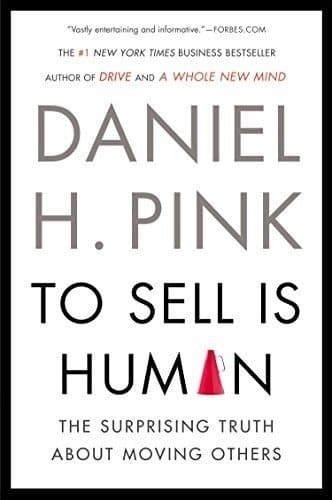
Selling isn't a profession anymore — it's a daily activity for everyone.
The big idea
Pink's central thesis is that one in nine Americans works in traditional sales, but the other eight in nine spend roughly 40% of their work time in 'non-sales selling' — persuading colleagues, students, kids, and bosses. The pushy-salesman caricature died with information parity: buyers can research more than any rep can pitch. Pink's new ABCs are Attunement (perspective-taking), Buoyancy (resilience after rejection), and Clarity (helping people see what they didn't see). He folds in research from psychology, behavioral economics, and improv to recast persuasion as a service skill rather than a manipulation art.
Everyone is in sales now — 'non-sales selling' fills 40% of every workday.
In 2012, Daniel Pink commissioned a survey of 7,000 American workers across industries and discovered that even those in non-sales jobs spent 41% of their work time trying to move others — pitching ideas, lobbying for resources, persuading skeptics. Teachers were selling engagement to bored students. Engineers were selling architectures to skeptical product managers. Parents were selling broccoli. The skill set traditionally walled off as 'sales' was now table stakes for almost every modern career.
Attunement: take the other person's perspective by lowering your status, not raising it.
Pink cites Adam Galinsky's research at Northwestern showing low-power negotiators outperform high-power ones in tasks requiring perspective-taking. In one experiment, participants assigned to high-power roles drew the letter E on their own foreheads from their own viewing perspective (illegible to others). Low-power participants drew it from the observer's perspective. Powerful people anchor on themselves. Less powerful people scan for what the other person needs.
Buoyancy: the positive-to-negative self-talk ratio that survives rejection.
Pink draws on Barbara Fredrickson's positivity-ratio research at UNC Chapel Hill and Martin Seligman's learned-optimism work at Penn to argue rejection-resilience is a learnable skill, not a personality trait. Fredrickson's data initially suggested a 3:1 positive-to-negative ratio for thriving — though the specific ratio has since been challenged. The underlying principle survives: how you talk to yourself before, during, and after rejection determines whether you call again tomorrow.
Clarity: the new rep finds problems people didn't know they had.
When buyers can google any product spec, the rep's value is no longer information delivery. Pink illustrates with the 2010 case of a software vendor whose customers were arriving at meetings already knowing more about the product than the sales rep. The rep's old role — explainer — had collapsed. The new role had to be something else: someone who could see the buyer's situation more clearly than the buyer could.
Pitch in modern formats: one-word, question, rhyming, subject-line, Twitter, Pixar.
Pink offers six modern pitch formats designed for distracted attention. The one-word pitch (Obama 2008's 'Forward,' Walmart's 'Save'). The question pitch ('Got milk?'). The rhyming pitch ('If the glove don't fit, you must acquit'). The subject-line pitch (compact and curiosity-piquing). The Twitter pitch (140-280 characters). And the Pixar pitch ('Once upon a time… every day… one day… because of that…').
Improv 'yes, and' beats prepared scripts in real conversations.
Pink visits Second City in Chicago, the improv comedy theater that trained Tina Fey, Stephen Colbert, and Steve Carell. He frames sales as live theater — and finds that the improv principles translate directly to objection handling. Hear offers, accept them, build on them, make your partner look good. The improvisor's discipline is the same as the seller's: respond to what's actually happening, not what was scripted.
Make it personal, make it purposeful — the two upgrades to any service interaction.
Pink cites Adam Grant's research at Wharton with hospital cleaning staff. Grant studied janitorial workers at a major teaching hospital and found those who knew which patients they served by name — and could see the impact of their work on patient recovery rates — outperformed identically trained peers on every measurable dimension. Personal-plus-purposeful turned identical work into vocation, and vocation produced measurably better performance.
The takeaway
Pink's gift is dissolving the wall between 'sales' and 'everyone else' — his survey showed 41% of every workday is spent moving others, whether you have the title or not. The new ABCs replace Glengarry's: Attunement, Buoyancy, Clarity. You leave less defensive about persuasion and more curious about it, ready to lower your status to read the room, ask 'will I?' instead of declaring 'I will,' and earn the meeting by finding problems the buyer hadn't yet articulated.