Tools of Titans
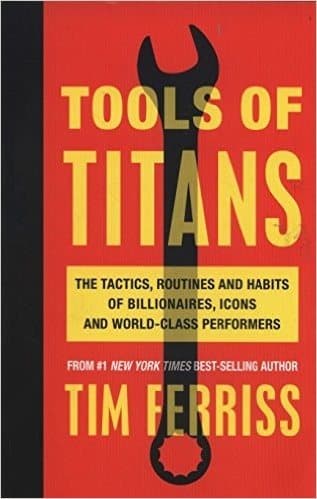
200+ world-class performers, distilled into the routines you can borrow.
The big idea
Ferriss compiled six years of long-form interviews from his podcast into a reference book of routines, tactics, and mental models from the world's top performers — athletes, billionaires, scientists, artists, special forces. It's not a single argument but a buffet: morning routines, decision frameworks, supplements, books-they-recommend. The pattern across guests — daily exercise, journaling, deliberate practice, fewer commitments — is the implicit thesis.
Most top performers share a few routines: morning movement, journaling, meditation, reading.
Tim Ferriss launched The Tim Ferriss Show in April 2014 and over the next several years interviewed more than 200 world-class performers — Arnold Schwarzenegger, Naval Ravikant, Tony Robbins, Arianna Huffington, Jocko Willink, BJ Miller, Jamie Foxx. He started keeping a notebook of recurring patterns. By 2016, when Tools of Titans went to print, the notebook had become a 700-page distillation of what the world's top performers actually did each morning.
5-Minute Journal: gratitude, intentions, evening review — works disproportionately well.
Ferriss credits the 5-Minute Journal format to its creators Alex Ikonn and UJ Ramdas, who launched the physical product in 2013. He built it into his own daily practice during a particularly bleak winter when he was stuck on a book project. Within a month his mood baseline lifted measurably. He calls it one of the highest-leverage habits he's tried — disproportionate effect for trivial cost.
The 80/20 review: what activities/people are creating 80% of joy and 80% of stress?
Ferriss runs a quarterly audit on his calendar and contact list. He lists everything that consumed his time in the prior 90 days, then stars the 20% producing disproportionate joy and the 20% producing disproportionate stress. He then deliberately schedules more of the first column and engineers the second column out — delegating, declining, automating, or eliminating. He's done it for over a decade and credits it as the highest-leverage life-design tool he uses.
Fear-setting beats goal-setting for most decisions stuck in indecision.
In 2004, Tim Ferriss was running BrainQUICKEN, a sports-supplement company, and felt trapped. He wanted to leave for a long trip abroad but couldn't pull the trigger — vague dread about what might happen. He sat down and wrote a three-page exercise: define the worst case, how to recover, the benefits of action, and the cost of inaction at six months and three years. The worst case turned out to be a 6/10 inconvenience. The cost of staying was a 9/10 erosion. He left, traveled, and wrote The 4-Hour Workweek.
Test in 30-day experiments — most life upgrades arrive disguised as small trials.
Ferriss treats almost every diet, supplement, training protocol, and habit as a 30-day experiment with metrics defined upfront. Cold showers. Sober January. Vegetarianism. Kettlebell-only training. No-news media. He commits for thirty days exactly, tracks specific numbers, and decides at day 30. Some experiments stuck — the slow-carb diet became permanent. Most didn't. The point isn't permanent change; it's accelerated learning about what works for him.
Define what 'success' would look like to you, not the world; otherwise you'll climb the wrong mountain.
Ferriss observed across hundreds of interviews that many of his guests had ostensibly 'made it' by external metrics — IPOs, championships, bestseller lists — and were still miserable. The most striking pattern: their definitions of success had been inherited from their twenties, and by their forties they'd hit the targets and felt nothing. He started asking every guest the same question: how do you define success today, and how was it different ten years ago?
If you can't decide, the answer is no.
Ferriss credits this rule to Derek Sivers' essay 'Hell Yeah or No,' which he describes as one of the most career-altering pieces he ever read. He recounts applying it to a six-figure speaking offer that gave him a faint 'maybe' — he declined, and a week later was offered a project with someone he'd long admired. The principle requires faith in opportunity-cost: every yes spends finite attention, and only 'hell yeah' returns enough to be worth it.
The takeaway
Ferriss's gift is the buffet, not the recipe. After watching 200+ world-class performers — Schwarzenegger, Naval, Jocko, Arianna — share a small overlap of practices (morning movement, journaling, meditation, fewer commitments), you stop hunting for one perfect routine and start running thirty-day experiments with measurable metrics. You leave with fear-setting on paper, the quarterly 80/20 audit, and Sivers's hell-yeah-or-no rule — climbing the mountain you actually chose, not the one you inherited.