Your Money or Your Life
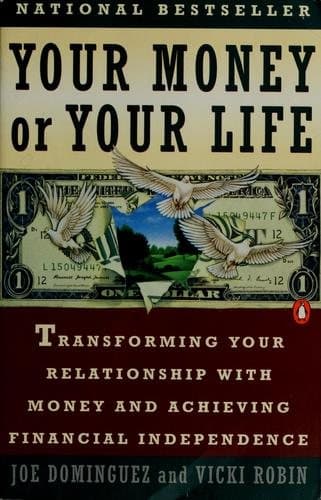
You trade your life energy for money — make every trade count.
The big idea
Robin and Dominguez treat money as 'life energy' — hours of your finite life exchanged for dollars. Their nine-step program asks you to compute your real hourly wage (after commute, work clothes, decompression), track every dollar, evaluate whether each spend brought fulfillment, and progressively close the gap between earning and meaning. The endgame is financial independence: passive income exceeding expenses.
Calculate your real hourly wage — most people earn far less than their stated salary suggests.
In 1990, Vicki Robin met a Boeing engineer named Bill at a Seattle workshop. Bill earned $45,000 a year — a respectable salary in his eyes, until Robin walked him through the calculation. Subtract commute (90 minutes round trip), suits, dry cleaning, the parking garage, the lunches out, the decompression beers, and the annual cruise he took to recover. His real wage came in at $7 an hour.
Track every dollar in and out, with no judgment — awareness alone shifts behavior.
Robin recounts a workshop attendee named Mark, an accountant in his forties, who logged every penny for three months and was stunned to find $1,400 he could not account for in memory — vending machines, snack runs, parking meters, impulse purchases at the register. The number wasn't shameful; it was data the unconscious had been hiding from the conscious for years.
Ask three questions of every expense: did I get fulfillment proportional to the life energy spent?
After tracking, Robin has you sort spending into categories — restaurants, books, clothes, transportation — and ask three questions of each. Did I receive fulfillment in proportion to the life energy spent? Was it aligned with my values? How would this change if I didn't have to work for money? Each category gets a +, -, or 0.
Enough is the point where more stops adding meaningful happiness — find yours.
Robin draws a fulfillment curve that rises from survival through comforts to luxuries, peaks at 'enough,' and descends into overconsumption — where stuff begins to bring stress, storage costs, and maintenance. Most Americans, she argues, have galloped past 'enough' without noticing the peak.
Frugality is freedom, not deprivation — fewer expenses means fewer hours owed.
Robin reframes frugality through its Latin root — frux, meaning fruit, value, enjoyment. To be frugal is not to want less but to extract more value from what you already have. Every dollar you don't need to spend is roughly thirty minutes of your life back from the employer.
Crossover point: investment income covers expenses and you no longer need to work for money.
Robin asks readers to plot two lines on a wall chart each month: total monthly expenses and total monthly investment income. Where investment income surpasses expenses, paid work becomes optional. This intersection — the crossover point — is the literal date of financial independence, visible months in advance.
Define what you'd do with your life if money weren't the question — then build toward it.
Robin runs a workshop exercise in which participants imagine a check arriving each month for life, covering all needs, and write down what they would actually do on Tuesday. The answers — read poetry, teach a grandchild to fish, restore an old motorcycle, finally finish the novel — almost never involve more income.
The takeaway
Robin and Dominguez's gift is repricing every purchase in the only currency that doesn't replenish. Once Bill the Boeing engineer's $30,000 Lexus reveals itself as 4,300 hours of life energy at his real wage of seven dollars, the fulfillment curve becomes a permission slip rather than a prison. You leave with the Tuesday list as your compass and the crossover point as a date on a chart, not a vague hope.