Summary
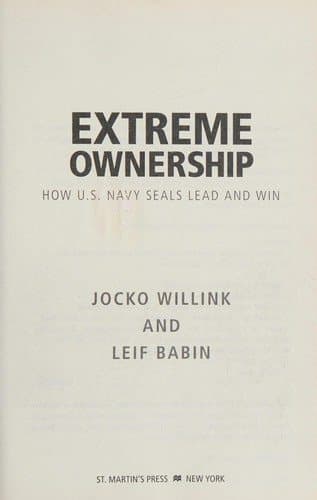
Willink and Babin, two former Navy SEAL officers who led Task Unit Bruiser through the 2006 Battle of Ramadi, argue that the principles that won the most kinetic urban combat of the Iraq War apply directly to running a business or a team. The central principle is Extreme Ownership: a leader takes responsibility for everything in their world — failures of subordinates, gaps in plans, communication breakdowns — without exception. From there flow the supporting laws: Cover and Move (teamwork over silos), Simple (plans must be understood by the lowest-ranking operator), Prioritize and Execute (handle one crisis at a time), and Decentralized Command (push decision authority down to the people closest to the problem). The book alternates a combat story, the leadership principle drawn from it, and the business application.
Key highlights
What we learned from Jocko Willink
Willink and Babin's gift is the only stance from which a leader has agency: there are no bad teams, only bad leaders, and every failure in your world is yours to own. The principles forged in Ramadi — Cover and Move, Simple, Prioritize and Execute, Decentralized Command — all flow from that root. You stop blaming your team, your CFO, your supply chain, because the moment you accept ownership the conversation shifts from excuses to action — and the next quarter starts turning around.