Summary
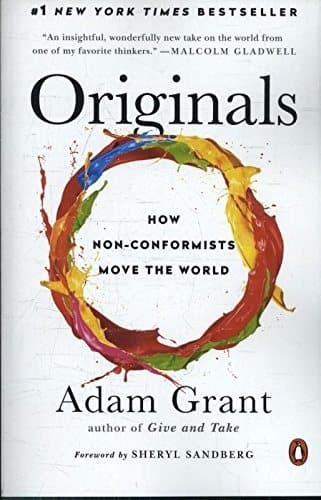
Grant's argument is that 'originals' — people who champion new ideas — look almost nothing like the swashbuckling risk-takers of myth. They hedge in one part of life so they can bet big in another. Bill Gates took a formal leave from Harvard rather than dropping out; Larry Page and Sergey Brin offered to sell Google to Excite for a million dollars and stayed in their Stanford PhD program through the early years; Warby Parker's founders lined up backup jobs that Grant misread as lack of commitment. Drawing on his Wharton research and case studies of Carmen Medina at the CIA, Edwin Land at Polaroid, Mahalia Jackson on the steps of the Lincoln Memorial, and Ray Dalio at Bridgewater, Grant maps how originals generate volume rather than precision, procrastinate productively, build coalitions, and design dissent into their teams. The book is a manual for the unspectacular work of pushing an unpopular idea through a system that doesn't want it.
Key highlights
What we learned from Adam Grant
Grant's gift is replacing the romance of the lone genius with the procedural reality of how new ideas actually get through. Once you see originals as hedgers, prolific tinkerers, strategic procrastinators, and dissent-architects — not as bold gamblers — the question stops being 'do I have the nerve?' and becomes 'have I designed the conditions where the nerve doesn't have to be the variable?' You leave looking less for the moment of courage and more for the structure that makes courage unnecessary.