Originals
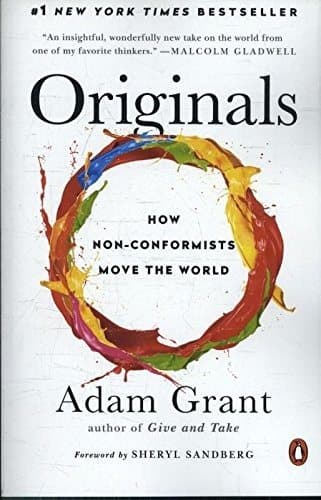
The non-conformists who change the world look ordinary — until you watch what they do with risk.
The big idea
Grant's argument is that 'originals' — people who champion new ideas — look almost nothing like the swashbuckling risk-takers of myth. They hedge in one part of life so they can bet big in another. Bill Gates took a formal leave from Harvard rather than dropping out; Larry Page and Sergey Brin offered to sell Google to Excite for a million dollars and stayed in their Stanford PhD program through the early years; Warby Parker's founders lined up backup jobs that Grant misread as lack of commitment.
Originals hedge bets — they reduce risk in one part of life to take bigger risks in another.
In 2009, four Wharton MBA students walked into Adam Grant's office with a pitch. Their names were Neil Blumenthal, Andy Hunt, Jeff Raider, and Dave Gilboa, and they wanted to sell prescription glasses online for ninety-five dollars. Grant passed on investing. The signal that swayed him: each of the four had a backup job lined up — investment banking, consulting, salaried roles — to fall back on if the company failed. He read it as a lack of commitment.
Vuja de — see the familiar with fresh eyes, then push the idea through the wall.
In the late 1990s, a CIA analyst named Carmen Medina pitched a heretical idea: agency analysts should share information online, in real time, rather than filing paper memos that took weeks to circulate. The agency's institutional response was to push her sideways. She was rotated into a backwater position, her reputation as a difficult employee following her, and the proposal died on the vine.
Volume beats precision — the most original thinkers are also the most prolific.
Berkeley psychologist Dean Simonton has spent decades cataloguing the output of creators across history. His finding is uncomfortable for the perfectionist: the people who produced the most masterpieces also produced the most flops. Mozart died at 35 with more than 600 compositions to his name. Bach wrote at least one piece every week for most of his career. Beethoven worked through hundreds of compositions in his notebooks — the symphonies that everyone knows came after a mountain of lesser work nobody listens to.
Procrastinate strategically — the right delay sharpens the idea before you commit.
On August 28, 1963, Martin Luther King Jr. stood on the steps of the Lincoln Memorial with a prepared speech in front of him. He had been writing and revising for days, and the manuscript he carried did not contain the words 'I have a dream.' He worked through the prepared text — the metaphor of the bad check on the promise of America, the urgency of now, the warning against bitterness — and was reading toward the conclusion. Behind him on the platform sat the gospel singer Mahalia Jackson.
Build dissent into the room — the strongest teams are the ones that argue best.
Ray Dalio founded Bridgewater Associates in 1975 out of his New York apartment. By the time Grant interviewed him, Bridgewater managed over $150 billion and had outperformed every other hedge fund in the world over the prior decade. Dalio's most-cited explanation for the performance was not stock picking. It was a workplace culture he called radical transparency, in which any employee could and should publicly challenge any other — including Dalio — on the merits of any decision.
The takeaway
Grant's gift is replacing the romance of the lone genius with the procedural reality of how new ideas actually get through. Once you see originals as hedgers, prolific tinkerers, strategic procrastinators, and dissent-architects — not as bold gamblers — the question stops being 'do I have the nerve?' and becomes 'have I designed the conditions where the nerve doesn't have to be the variable?' You leave looking less for the moment of courage and more for the structure that makes courage unnecessary.