Antifragile
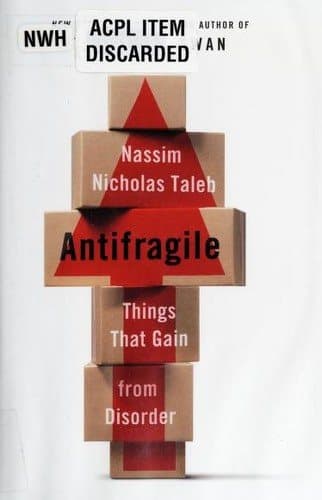
The opposite of fragile isn't sturdy — it's the thing that grows stronger every time the world tries to break it.
The big idea
Nassim Nicholas Taleb argues that the world is divided into three kinds of things: the fragile, which break under stress; the robust, which merely endure it; and the antifragile, which actually improve from volatility, disorder, and shocks. He coins the word because no language had one — and insists antifragility is the hidden engine behind evolution, innovation, muscle growth, and functioning markets.
Antifragility is beyond resilience: some things actually gain from disorder.
Taleb starts with a gap in language. We have a word for things that break under stress — fragile — but no real word for the opposite. People reach for "robust" or "resilient," yet those only describe something that survives a shock unchanged. He imagines a package in the mail: the opposite of one stamped FRAGILE is not a package stamped ROBUST, which merely arrives intact, but one you could stamp PLEASE MISHANDLE, because it would show up better for the rough treatment. That third category had no name, so he invented one.
What kills the individual can strengthen the collective — and stressors strengthen us too.
Consider Mithridates VI, king of Pontus, who lived in terror of being poisoned by his rivals. Rather than hide from the threat, he reportedly swallowed sub-lethal doses of poisons day after day, training his body to neutralize them. The strategy worked so well it gave us a word — mithridatization — for building immunity through controlled exposure to the very thing that should harm you.
The barbell strategy: combine extreme safety with small, capped, high-upside risks.
Taleb spent years as an options trader, a job that forces a brutal question: how do you act when the future is genuinely unknowable? His answer is not better prediction. It is a particular shape of exposure he calls the barbell — weight piled on the two far ends and nothing in the fragile middle.
Via negativa: you improve more reliably by subtracting harm than by adding fixes.
We know far more about what is wrong than about what is right, Taleb argues, and that asymmetry should reshape how we act. Knowledge by removal is sturdier than knowledge by addition. He borrows the term via negativa from theology, where God was described not by listing his attributes but by stripping away everything he is not.
Skin in the game: never trust a decision from someone shielded from its downside.
Taleb saves his fiercest argument for ethics. The most fragilizing force in modern life, he says, is the people who have figured out how to keep the upside of their decisions while transferring the downside onto everyone else — bankers who pocket the bonuses and hand the losses to taxpayers, pundits and forecasters who pay no price at all for being catastrophically wrong.
The takeaway
Taleb's gift is a new lens: stop asking whether something will survive the next shock and start asking whether it can be built to gain from it. The practical handles — barbell your risks, improve by subtraction, and refuse to trust anyone who has no skin in the game — are less about predicting the future than about arranging your life so that an unpredictable world tilts in your favor. The deepest lesson is that comfort and the suppression of all volatility are not safety; they are how fragility quietly accumulates.