Blink
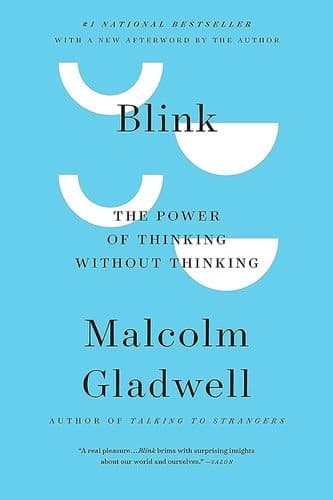
The first two seconds of judgment can be more accurate than weeks of analysis.
The big idea
Gladwell explores 'thin-slicing' — the brain's ability to draw accurate conclusions from very limited information. Art experts spotting a forgery, gamblers picking the rigged deck, marriage researchers predicting divorce in 15 minutes: rapid cognition, when trained, is uncannily good. But it can also fail spectacularly under stress, racial priming, or information overload. The book is a study of when to trust your gut and when not to.
Thin-slicing: experts can extract meaningful patterns from very little data.
In September 1983, the J. Paul Getty Museum was offered a 7-foot Greek kouros statue dating to the 6th century BC. Lawyers spent fourteen months investigating the provenance. Geologist Stanley Margolis used an electron microscope to confirm the dolomite marble had aged for thousands of years. The Getty paid $7 million and announced the acquisition in 1986.
More information often degrades judgment past a certain point.
Cook County Hospital's emergency room handled some of Chicago's poorest patients, and chest pain was its most common complaint. In 1996, cardiologist Brendan Reilly inherited a problem: doctors were ordering full workups on everyone, beds were full, and misdiagnoses were still happening. He found a 1970s algorithm by cardiologist Lee Goldman that asked just three risk factors plus the ECG.
Stress narrows attention to the point of tunnel vision — slow down before deciding.
On February 4, 1999, just after midnight, four NYPD plainclothes officers in the Bronx approached 22-year-old Amadou Diallo on the steps of his apartment building. Diallo reached into his jacket for his wallet. Officer Sean Carroll yelled 'Gun!' Within seconds the officers fired 41 rounds. Diallo was hit 19 times. He had no weapon.
Implicit bias shapes split-second judgments; awareness reduces but doesn't erase it.
Mahzarin Banaji at Harvard and Anthony Greenwald at the University of Washington built the Implicit Association Test in 1998. Subjects sort words into categories — flowers/insects, then good/bad, then both combined. The reaction-time gap when 'Black' is paired with 'good' versus 'bad' reveals associations that don't show up on surveys.
Train rapid cognition deliberately — exposure plus feedback turns intuition into expertise.
John Gottman built his 'Love Lab' at the University of Washington in 1986. Couples spend a weekend in a studio apartment outfitted with cameras and physiological sensors. Gottman codes their interactions on the SPAFF system — twenty emotional categories tagged second by second. After 15 minutes of reviewing footage, he can predict with 95% accuracy whether the marriage will end in divorce.
Locked doors: protect intuitive decisions from premature explanation.
Jonathan Schooler at the University of Pittsburgh ran experiments asking subjects to taste jams and then either describe their reasons for liking each one or not. Subjects forced to verbalize their preferences ranked the jams more like novices and less like Consumer Reports' trained tasters. Putting words to a thin-slice corrupted it. Schooler called the effect 'verbal overshadowing.'
Sometimes too many choices produce worse outcomes than fewer — paradox of choice in action.
Sheena Iyengar, then a Stanford graduate student, set up a tasting booth at Draeger's Market in Menlo Park in 1995. On some days she displayed 24 jams; on others, 6. The 24-jam display attracted more shoppers — 60% stopped versus 40% — but only 3% of them bought. The 6-jam display: 30% bought. A ten-fold difference in conversion from one variable: choice count.
The takeaway
Gladwell's gift is rehabilitating the gut without romanticizing it. Through the Getty kouros that experts knew was wrong in two seconds and Gottman's fifteen-minute divorce predictions, you learn that thin-slicing is uncannily accurate when trained — and dangerously wrong when stressed, primed, or asked to explain itself. You leave less interested in choosing between intuition and analysis, and more interested in knowing which domain you're standing in before you trust either one.