Eat That Frog!
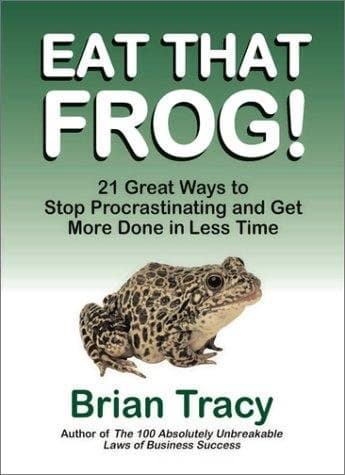
Do the worst thing on your list first — the rest of the day gets easier.
The big idea
Tracy's book is a tight collection of 21 productivity principles built around one image: if your job is to eat a live frog, do it first thing in the morning. The 'frog' is your most important, most-procrastinated task. Tackle it before email, before meetings, before easier wins, and momentum carries the day. The book is short, repetitive in the right way, and unusually actionable.
Identify your one biggest, most-impactful task — and do it first thing.
The image at the heart of Tracy's book comes from a line attributed to Mark Twain: if your job is to eat a live frog, eat it first thing in the morning, and the rest of the day will look pretty good. The frog, Tracy argues, is the one task with the most consequence and the most resistance — usually the one that's been on your list for days.
Apply the 80/20 rule — 20% of tasks produce 80% of value; protect those.
In 1906 the Italian economist Vilfredo Pareto noticed that twenty percent of the peapods in his garden produced eighty percent of the peas. He found the same ratio in Italian land ownership, then in business sales, then in nearly every distribution he tested. The law has held for over a century in domains Pareto never imagined.
Plan tomorrow tonight, on paper, and start the day with the plan in front of you.
Dwight Eisenhower famously refused to retire each evening without his next-day priority list complete. As Supreme Allied Commander preparing the D-Day invasion, he insisted the planning was what made the spontaneity of leadership possible during the day's emergencies. Tracy adopts the principle: every minute spent in planning saves ten in execution.
Single-handle every task — start it, work it through, finish it before switching.
Tracy cites psychologist Gerald Weinberg's estimate that a single interruption costs roughly twenty-eight minutes of recovered focus, even if the interruption itself lasted ninety seconds. Switching between tasks can multiply the time required by up to five times — every interruption is followed by a mental restart that costs minutes.
Use the ABCDE method to ruthlessly rank tasks by consequence.
Tracy's ABCDE method assigns every task a letter. A = must do, with serious consequence for skipping. B = should do, mild consequence. C = nice to do, no consequence. D = delegate. E = eliminate. The rule that makes the system work: never do a B task while an A task remains undone, and never do a C task at all if A's are still on the list.
Slice and dice big tasks — small bites overcome inertia.
Tracy recounts coaching a writer who had stalled for three years on a 300-page book by trying to start chapter one perfectly. The intervention was simple: write three sentences a day, no more allowed. Within a year the manuscript was complete because three sentences felt unrefusable while a chapter felt impossible.
Develop a sense of urgency — the action habit beats the perfection habit.
Tracy profiles top performers who deliberately project urgency in how they walk, talk, and start tasks. Studies of high-performing executives suggest they walk roughly thirty percent faster than peers, return phone calls within hours rather than days, and start meetings three minutes early as a deliberate signal.
The takeaway
Tracy's gift is the brutal clarity of identifying the one task whose completion would have made the rest unnecessary — and chewing it before email opens. The painful-but-pivotal frog dies first; the painful-but-trivial substitutes get unmasked; single-handling becomes the unfair advantage hiding in plain sight. You leave sketching tomorrow's six priorities on an index card the night before, ranking them ABCDE, and refusing to do a B while an A still breathes.