Freakonomics
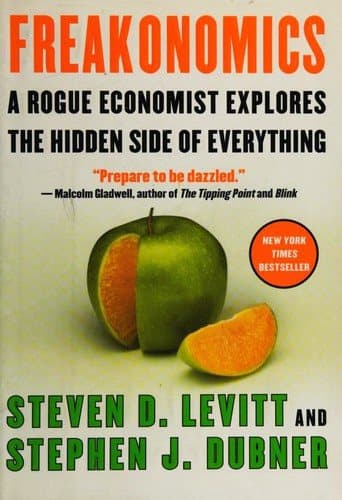
A rogue economist takes cold data to everyday life — and uncovers the hidden incentives steering sumo wrestlers, schoolteachers, and the 1990s crime drop.
The big idea
Freakonomics isn't about money — it's about how people actually behave once you strip away the stories they tell themselves. University of Chicago economist Steven Levitt teams with journalist Stephen Dubner to argue that economics is really the study of incentives, and that almost any riddle yields to good data and a willingness to ask odd questions. They show Chicago schoolteachers and Japanese sumo wrestlers cheating in the same telltale patterns, real-estate agents quietly working against their own clients, and the Ku Klux Klan undone less by force than by leaked information.
Incentives rule behavior: change the price of an act and you change how often people do it — sometimes backward.
In 1998, two economists, Uri Gneezy and Aldo Rustichini, ran an experiment at ten day-care centers in Haifa, Israel. Parents who picked their children up late were now fined a small sum — about three dollars per child. The economists expected lateness to fall. Instead it roughly doubled. The fine had quietly converted a moral failing — leaving a tired teacher waiting — into a cheap service that parents could simply buy.
Conventional wisdom is often manufactured — and an expert's incentives may not be yours.
The economist John Kenneth Galbraith coined the phrase 'conventional wisdom,' and he didn't mean it kindly. He argued that we embrace certain ideas because they are comfortable and familiar, not because they are true — and that comfort makes them remarkably hard to dislodge, even when the facts have moved on.
Information is power — and whoever controls it controls the outcome.
In the 1940s, a Florida man named Stetson Kennedy infiltrated the Ku Klux Klan, patiently collecting its secret passwords, rituals, and code words. Rather than hand his haul to the police, he fed it to an unlikely ally: the producers of the Adventures of Superman radio serial. For several weeks, Superman's villains were Klansmen, and children across America acted out the Klan's sacred secret rites in their backyards as a game.
The cause of a dramatic effect is often distant, quiet, and nothing like the obvious story.
By the early 1990s, American violent crime had been climbing for decades, and criminologists were forecasting a coming wave of teenage 'superpredators.' Instead, crime fell — sharply, nationwide, across nearly every category. Experts rushed to claim the credit: innovative policing, tougher gun laws, a booming economy, the expansion of prisons.
With parenting, who you are matters far more than what you do.
The U.S. Department of Education's Early Childhood Longitudinal Study tracked the school performance of more than 20,000 children, recording almost everything about their homes. When Levitt mined the numbers, a strange pattern surfaced. Having many books in the house was strongly correlated with high test scores. But whether a parent read to the child every single day was not.
The takeaway
Levitt and Dubner hand you a lens, not a list of answers: behind every puzzling outcome sits an incentive, and behind every confident expert sits an information advantage. The discipline they teach is to distrust the obvious story, separate a marker from a cause, and let honest measurement — however inconvenient — settle the question.