Getting to Yes: Negotiating Agreement Without Giving In
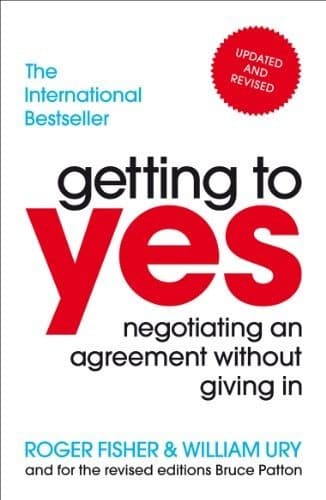
Negotiation isn't a contest of wills — it's a search for the deal both sides would have made if they'd been smarter from the start.
The big idea
Fisher and Ury, leaders of the Harvard Negotiation Project, dismantle the assumption that bargaining is a zero-sum fight between hard and soft styles. They propose principled negotiation, built on four moves: separate the people from the problem, focus on interests rather than positions, invent options for mutual gain, and insist on objective criteria. Each principle has a story behind it — Egypt and Israel at Camp David, two children fighting over an orange, a library where one reader wants the window open and the other wants it closed.
Don't bargain over positions: the trap that turns negotiation into a contest of wills.
A buyer offers two hundred dollars for the antique table. The seller asks four hundred. They haggle until they meet at three hundred, both half-satisfied, both certain the other won out. Fisher and Ury call this positional bargaining — and they argue it's the default trap of nearly every negotiation. Each side picks a position, hardens it under pressure, then trades concessions until exhaustion produces a deal.
Separate the people from the problem: treat the counterparty as a partner against the issue, not as the issue itself.
A husband and wife arguing about a remodeling budget rarely stay on the budget. Within ten minutes they're arguing about whether the other one respects them, listens to them, takes their wishes seriously. The substance is gone; only the wound remains. Fisher and Ury argue that this is the default mode of human negotiation — confusing what we want with who we are.
Focus on interests, not positions: the orange story and why most deals leave value on the table.
Two children fight over the last orange in the kitchen. After ten minutes of escalating noise, their mother cuts the orange in half and gives each child a piece. One child eats the fruit and throws away the peel. The other throws away the fruit and grates the peel for a cake. Both got half of what they wanted. Both could have had all of it.
Invent options for mutual gain: separate the act of creating from the act of deciding.
A typical negotiation, Fisher and Ury observe, generates one or two options on the table and then spends hours fighting over them. The fight is in fact a sign that the parties skipped a step. They tried to decide before they tried to invent. The result is a cramped choice between alternatives that satisfy neither side.
BATNA: your power in any negotiation is the quality of your alternative to it.
A homeowner is negotiating with a contractor. The contractor is being difficult. The homeowner threatens to walk away. The contractor shrugs. The homeowner caves. What just happened, Fisher and Ury argue, is that the homeowner overestimated his power because he never seriously developed an alternative. He had no other contractor lined up. His threat was empty and the contractor smelled it.
The takeaway
Fisher and Ury reframe negotiation from a battle between hard and soft styles into a joint search for principled agreement, anchored by four moves and one diagnostic — your BATNA. The book's lasting gift is a vocabulary precise enough to make the invisible parts of a deal — interests, alternatives, fair process — finally negotiable. Get good at the four moves and most positional fights stop being fights at all.