Grit
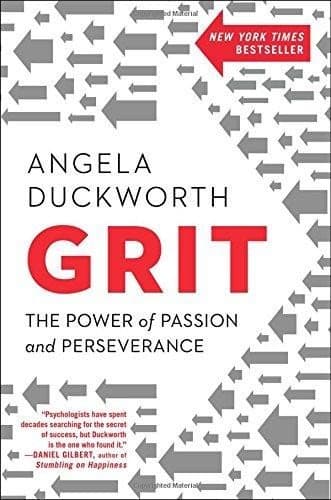
Talent is overrated; sustained passion plus perseverance wins.
The big idea
Duckworth's longitudinal research at West Point, the National Spelling Bee, and elite schools shows that grit — passion and perseverance for long-term goals — predicts success better than IQ or talent. Effort counts twice in her formula: talent × effort = skill, skill × effort = achievement. Grit can be grown via interest, deliberate practice, purpose beyond self, and hope.
Effort counts twice — talent without effort produces nothing meaningful.
Warren MacKenzie was one of the most important American studio potters of the twentieth century. He spent his career throwing thousands of pots a year at his Stillwater, Minnesota studio. Asked how he produced such consistently fine work, he answered that talent gave him five to ten 'keepers' annually — pots good enough to keep — but only the volume produced those keepers in the first place. Take away the volume and the talent has nothing to refine.
Grit is passion plus perseverance, sustained over years not days.
Each summer about 1,200 cadets enter West Point and undergo seven brutal weeks of basic training called Beast Barracks. The dropout rate is significant. In 2004 Duckworth was given access to study which cadets would survive. She measured strength, athletic ability, SAT scores, and high-school class rank — none predicted who would quit. Then she administered her 12-question Grit Scale, and that single measure predicted dropout with striking accuracy.
Find a 'top-level goal' — a north star — and prune lower goals that don't serve it.
Duckworth borrows an exercise attributed to Warren Buffett: list your 25 top career goals, circle the top 5, then commit to avoiding the other 20 at all costs because they are precisely what will distract you from the 5. Most people, surveyed, would have agreed they should focus on five. Almost none had explicitly written the list and crossed off the rest.
Deliberate practice: stretch goals, full focus, immediate feedback, repetition.
In the early 1990s, K. Anders Ericsson studied violinists at the Berlin Music Academy, dividing them into 'good,' 'better,' and 'best' tiers. The single consistent differentiator was not talent, IQ, or family background — it was hours of solitary deliberate practice. By age 20, the merely good had logged about 4,000 hours; the best, about 10,000. Duckworth treats this study as foundational, with one critical caveat she repeats often.
Purpose — work that helps others — fuels long-term grit better than self-interest.
Duckworth uses the parable of the three bricklayers, asked the same question on the same construction site. The first answers, 'I'm laying bricks.' The second, 'I'm building a church.' The third, 'I'm building the house of God.' All three are doing identical work. Only one will still be doing it with full engagement in twenty years. Purpose is what distinguishes the third bricklayer from the first.
Hope is learned: setbacks are temporary, specific, and addressable.
In the late 1960s, the psychologist Martin Seligman accidentally discovered learned helplessness while running shock-avoidance experiments on dogs. Dogs given inescapable shocks, when later placed in escapable situations, simply lay down and accepted the shock. The pattern transferred. Decades later Seligman extended the research to humans and found that explanatory style — how people interpret bad events — could be measured, and could be changed.
Surround yourself with a gritty culture; environment shapes behavior more than willpower.
Duckworth quotes a Navy SEAL she interviewed: 'You don't have to be a hero around here. You just have to live up to the expectations that everyone else is living up to.' The line captures the entire mechanism. In a culture where grit is the default, grit becomes effortless because the alternative is social isolation. In a culture where mediocrity is the default, even highly gritty individuals burn out fighting the current.
The takeaway
Duckworth's gift is the unromantic equation that effort counts twice — once to build skill, again to deploy it — and that passion is not a spark but a slow-built loyalty to a top-level goal. The West Point cadets who survived Beast Barracks were not the strongest or smartest; they were the ones whose compass held through changing weather. You leave asking whether you'll still want this in five years, and whether the room you're in is gritty enough to carry you when willpower fails.