Influence
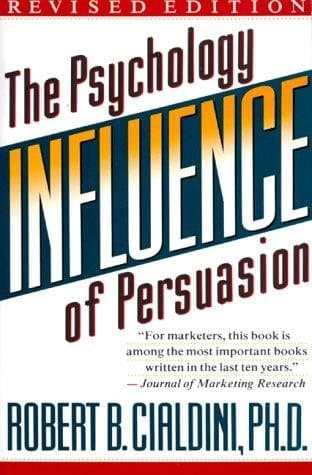
Six universal principles drive most yes-answers humans give.
The big idea
Cialdini's seminal work catalogs the psychological levers that make people say yes: reciprocity, commitment/consistency, social proof, liking, authority, and scarcity. He calls them 'weapons of influence' because they trigger automatic, often unconscious compliance. The book is essential reading for anyone in marketing, sales, or negotiation — and for anyone who wants to recognize when these levers are being used on them.
Reciprocity: free samples and small gifts create powerful pressure to give back.
Beginning in the early 1970s, Hare Krishna devotees fanned out across U.S. airports to hand travelers a flower or paperback as 'a gift.' Donations followed within seconds of the gift landing in the traveler's hand. The donations totaled millions before newspapers ran investigative pieces and travelers learned to refuse the flowers. The mechanism was so reliable airports eventually banned the solicitations outright.
Commitment & consistency: small initial commitments lead to bigger aligned ones.
In 1966, Stanford researchers Jonathan Freedman and Scott Fraser ran the now-classic Palo Alto homeowner study. They asked residents directly to install a giant 'DRIVE CAREFULLY' billboard on their front lawn — most refused. But homeowners who'd first agreed two weeks earlier to display a tiny three-inch window sticker said yes to the billboard 76% of the time. The small early yes shifted self-image; the larger yes followed naturally.
Social proof: people look to others to decide what's correct, especially under uncertainty.
On March 13, 1964, Kitty Genovese was murdered outside her apartment building in Queens. Initial New York Times reports claimed 38 witnesses watched and did nothing. The Times account was later partially debunked, but the case launched social psychologist Bibb Latané's bystander research at NYU — a programmatic study showing that people in groups under uncertainty look at each other to decide what to do, and freeze when no one moves first.
Liking: we say yes to people we like — similarity, compliments, cooperation drive it.
Joe Girard sold more cars than any individual salesperson in U.S. history — for twelve years running, listed in the Guinness Book of World Records. He didn't have territory, low prices, or special access. What he had was a card. Every customer received a holiday card every month, every month, with the same six-word message: 'I like you. — Joe Girard.' His repeat sales rate was extraordinary.
Authority: titles, uniforms, and props shift compliance dramatically.
Stanley Milgram's 1961 experiments at Yale told subjects they were participating in a learning study and instructed them to administer increasingly painful electric shocks to a 'learner' (actually a confederate). When the learner began screaming and asking to stop, 65% of subjects continued all the way to 450 volts — labeled XXX on the dial — because a man in a lab coat said 'continue.'
Scarcity: rare, time-limited things feel more valuable, even when they aren't.
Cialdini cites a beef-importer study by University of Iowa researcher Amram Knishinsky. Sales pitches mentioning a possible Australian beef shortage doubled orders. Adding 'and we got this information from an exclusive source' tripled them. The information was identical; the scarcity framing combined with exclusivity multiplied response. The customers were professional buyers, not impulse shoppers.
Recognize the levers being used on you — that recognition alone restores choice.
Cialdini opens the book with his most embarrassing personal story. Walking through a Native American jewelry shop in Arizona, he bought a turquoise piece on impulse — only to learn later that the shop owner, frustrated her stock wasn't selling, had told her clerk to cut the price by half. The clerk misread '½' as '2' and doubled prices instead. The doubled stock sold out within days.
The takeaway
Cialdini's gift is naming the six levers that have been pulling you all along. Once you've seen Hare Krishna flowers, the Palo Alto billboard study, and Joe Girard's monthly 'I like you' cards, you can't unsee reciprocity, commitment, social proof, liking, authority, and scarcity at work in every pitch. You leave not immune — Cialdini admits he isn't either — but slower to click-whirr, with the option to choose your yes back in your hands.