Leaders Eat Last
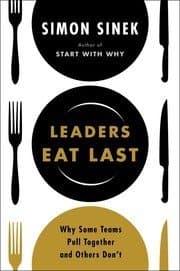
Leadership is a choice to put the well-being of your people above your own.
The big idea
Sinek argues that great leaders create what he calls a Circle of Safety — an environment where people feel protected from internal threats so they can focus their energy on external ones. He grounds the argument in biology: four chemicals (endorphins, dopamine, serotonin, oxytocin) drive our social behavior, while a fifth (cortisol) corrodes trust. When leaders prioritize numbers over people, cortisol floods the organization and cooperation collapses.
True leaders eat last — they sacrifice their own comfort for their people.
Sinek opens with a scene from a Marine Corps chow line. He's having dinner with Lieutenant General George Flynn, watching the most junior Marines step up to eat first while the senior officers wait at the back of the line. There is no rule that mandates this. There is no order. It is simply what Marines do, and have always done.
The Circle of Safety: protect your people from internal threats so they can face external ones.
In 2008, as the financial crisis sent waves of layoffs across American manufacturing, Bob Chapman — the CEO of Barry-Wehmiller, a $1.5 billion machinery conglomerate based in St. Louis — faced a 30% drop in new orders. The board expected layoffs. Chapman refused. Instead he announced a mandatory furlough program: every employee, from the C-suite to the factory floor, would take four weeks of unpaid leave during the year.
The four chemicals of leadership: endorphins, dopamine, serotonin, and oxytocin — and the cortisol that destroys them.
Sinek devotes the central chapters of the book to a biological framework borrowed from neuroscience. Two chemicals — endorphins and dopamine — are selfish. They evolved to drive an individual to find food, achieve goals, and push through pain. Two more — serotonin and oxytocin — are selfless. They reward cooperation, trust, and belonging. Together, the four make humans the most successful social species on the planet.
Empathy is a leadership skill, not a soft virtue.
Charlie Kim founded Next Jump, a New York e-commerce company, in his Tufts dorm room in 1994. By the early 2000s the company was thriving, but Kim noticed that his best people were burning out and his culture was hardening. In 2012, he announced a policy that no Wall Street CEO would have signed: lifetime employment. Once you joined Next Jump, you could not be fired for performance.
Abundance of information without abundance of trust produces dysfunction.
Sinek uses Captain Mike Drowley — call sign 'Johnny Bravo' — as the human face of trust under fire. Drowley flew an A-10 Warthog over Afghanistan in 2002, descending through cloud cover at night to provide close air support for Special Forces troops pinned down in a valley. He couldn't see the ground. He had to trust the controller on the radio. The controller, in turn, had to trust that Drowley would risk himself to come down through the weather.
The takeaway
Sinek's gift is grounding leadership in biology: a Circle of Safety releases oxytocin and serotonin, while internal threats flood the org with corrosive cortisol. The Marine officers who literally eat last, Bob Chapman's furloughs at Barry-Wehmiller, Johnny Bravo descending through cloud cover — each shows the same pattern. You leave understanding that leadership is responsibility, not rank, and that the cost you absorb for your people is what releases the chemistry that makes the work remarkable.