Letters to a Young Poet
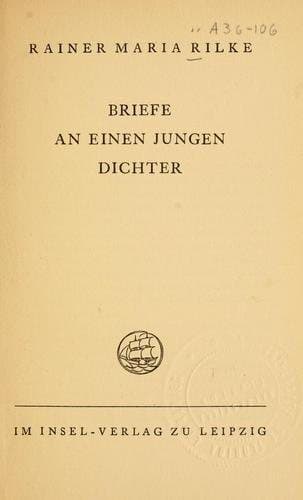
A renowned poet answers a young soldier's letters — and teaches every searching person to stop demanding answers and learn to live the questions instead.
The big idea
In 1902 a nineteen-year-old military cadet named Franz Xaver Kappus, unsure whether to become a poet or a soldier, sent some of his verses to Rainer Maria Rilke and asked for judgment. Rilke — only twenty-seven himself, newly arrived in Paris to write a study of the sculptor Auguste Rodin — refused to grade the poems and instead wrote back about how to live. Over ten letters between 1903 and 1908, sent from Paris, Italy, and Sweden, he counsels solitude, patience, and an unflinching turn inward.
Don't ask the world if your work is good: ask yourself whether you must do it at all.
Franz Xaver Kappus was a cadet at the Theresian Military Academy in Wiener Neustadt when he discovered that the poet Rainer Maria Rilke had once walked the same grim corridors as a boy. In the autumn of 1902, restless under the prospect of an officer's career, the nineteen-year-old wrapped up some of his own poems and mailed them to Rilke with a single request: tell me whether these are any good. He wanted a verdict — a critic's thumbs up or down that would decide his future.
Stop demanding answers to what you can't yet answer — live the questions instead.
By the fourth letter, written in the summer of 1903 from the Italian coast at Viareggio, Kappus had poured out the doubts of a man in his early twenties — about love, about sex, about doubt itself, about whether his whole life was taking the wrong shape. He wanted resolution. He wanted Rilke to hand him the conclusions that would let him stop aching. Rilke refused that too, but more tenderly than before.
Solitude is not a punishment to escape but the soil where an inner life grows.
Kappus, surrounded by fellow cadets and later by the company of an army post, complained of loneliness, as the young almost always do. He treated his solitude as a deficiency — a sign that something had gone wrong, a state to be cured by other people. Writing in 1904, partly from the Swedish estate of Borgeby gard, Rilke turned the complaint completely inside out.
Don't flee your sadness and difficulty — they are the moments life is working on you.
Some of Rilke's most quoted lines come from the eighth letter, written from Sweden in 1904, when he turned to the subject of sadness — the heavy, formless moods that fall on us without explanation. Kappus, like most people, treated such feelings as intruders to be pushed out as fast as possible. Rilke asked him to do the opposite: to sit still inside them and trust that something was happening.
Criticism can't reach a true work — only love and your own ordinary life can feed it.
Having been asked, in the very first letter, to act as a critic, Rilke instead dismantled the value of criticism altogether. Kappus had assumed that a sharp external judgment would tell him whether his work — and by extension his life — was worthwhile. Rilke told him that no review, however clever, could ever truly touch the thing it was judging.
The takeaway
Rilke's gift is to take a young person's frantic demand for answers and replace it with a slower, braver way of living — turning inward to find what is necessary, embracing solitude and difficulty rather than fleeing them, and trusting that an unresolved life can be inhabited until it ripens. He never tells Kappus what to choose; he teaches him how to wait, how to look, and how to love the questions. More than a century on, the letters still read as counsel written directly to anyone standing at the edge of their own unanswered life.