Made to Stick: Why Some Ideas Survive and Others Die
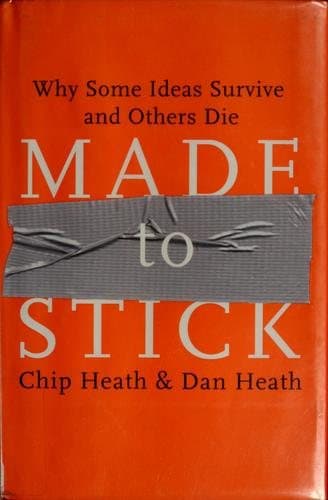
Some ideas spread like wildfire and others die in committee — the Heath brothers identify six structural traits that separate sticky messages from forgettable ones.
The big idea
Brothers Chip and Dan Heath spent a decade studying why some ideas — urban legends, classroom lessons, presidential speeches, corporate slogans — survive transmission while others die at birth. Their answer is the SUCCES framework: sticky ideas are Simple, Unexpected, Concrete, Credible, Emotional, and built around Stories. The book opens with the kidney heist legend, a cocktail-bar story so structurally airtight that nobody who hears it forgets the bathtub of ice, and uses it to dissect what each trait does.
The Curse of Knowledge: once you know something, you cannot un-know it for the person you are trying to reach.
In 1990, Stanford psychology Ph.D. student Elizabeth Newton designed a deceptively simple experiment for her dissertation. She paired people up and assigned half of them the role of 'tapper' and half the role of 'listener.' Tappers were given a list of 25 well-known songs — 'Happy Birthday,' 'The Star-Spangled Banner' — and asked to tap out the rhythm of one on a tabletop. Listeners had to guess the song. Before each round, tappers predicted how often listeners would correctly identify the tune.
Simple means find the core — and then ruthlessly cut everything that is not it.
Herb Kelleher, Southwest Airlines' co-founder, ran the company for decades around five words: THE low-fare airline. The Heaths describe a moment when a marketing executive named Tracy approached him with research suggesting passengers on a longer flight would appreciate a chicken Caesar salad. Kelleher's reply, which has since become a Southwest legend, was a single question. Will adding that chicken Caesar salad make us THE low-fare airline?
Concrete details turn an abstraction into something a stranger can picture without your help.
On May 25, 1961, John F. Kennedy stood before a joint session of Congress and committed the United States to the most ambitious engineering project of the century. He could have said the country needed to reaffirm its leadership in space, or invest in technological excellence, or inspire the next generation. Each of those phrasings would have been forgotten by the next news cycle. Instead, he chose words that any janitor at NASA could test against.
Emotional means making people care about one Rokia, not a continent of statistics.
Researchers Deborah Small, George Loewenstein, and Paul Slovic at Carnegie Mellon ran a now-classic study on charitable giving. Subjects who completed a survey were given five one-dollar bills and an envelope with one of two appeals from Save the Children. The first appeal listed the statistics: food shortages in Malawi affecting more than three million children, three million Angolans driven from their homes, four million Ethiopians needing immediate food assistance. The second appeal told the story of a single seven-year-old girl from Mali named Rokia whose poverty would be eased by the recipient's gift.
Stories are flight simulators for the brain — listeners rehearse the action before they ever try it.
Roone Arledge took over ABC Sports in the early 1960s and inherited a problem familiar to every Olympic broadcaster. American audiences had no reason to care about a Norwegian biathlete or a Romanian gymnast they had never heard of. Arledge's solution was the 'up close and personal' segment — a two-minute story about the athlete's life, family, and obstacles, run before the event. Ratings for events that included an athlete profile outperformed straight competition coverage by enormous margins. Audiences were not suddenly more interested in the biathlon. They were interested in the biathlete.
The takeaway
The Heath brothers' gift is reframing stickiness as a craft instead of a gift. Once you see that the kidney heist legend and JFK's moonshot share six engineerable traits — Simple, Unexpected, Concrete, Credible, Emotional, Stories — communication stops feeling like charisma and starts feeling like a checklist you can audit before the meeting. You leave asking a different question of every message you send: not 'is this true?' but 'will the listener be able to retell this accurately to a stranger by Friday?'