Summary
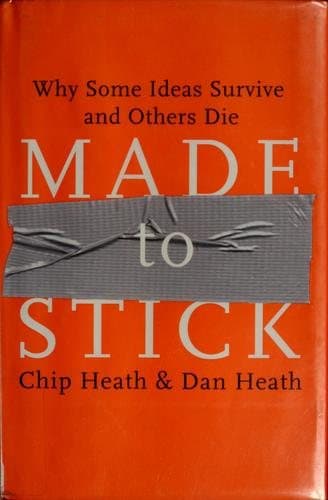
Brothers Chip and Dan Heath spent a decade studying why some ideas — urban legends, classroom lessons, presidential speeches, corporate slogans — survive transmission while others die at birth. Their answer is the SUCCES framework: sticky ideas are Simple, Unexpected, Concrete, Credible, Emotional, and built around Stories. The book opens with the kidney heist legend, a cocktail-bar story so structurally airtight that nobody who hears it forgets the bathtub of ice, and uses it to dissect what each trait does. Along the way the Heaths analyze JFK's 1961 moonshot speech, Herb Kelleher's 'THE low-fare airline' mantra, James Carville's three-line whiteboard during the 1992 Clinton campaign, and the 1990 Stanford 'tappers and listeners' experiment that gave the Curse of Knowledge its name. The argument cuts against the cult of the genius communicator: stickiness is not luck or charisma, it is craft, and the craft is teachable. The villain throughout is abstraction — the senior leader's instinct to compress everything into 'world-class customer experience' rather than the Aesop's-fable specificity that actually travels.
Key highlights
What we learned from Chip Heath
The Heath brothers' gift is reframing stickiness as a craft instead of a gift. Once you see that the kidney heist legend and JFK's moonshot share six engineerable traits — Simple, Unexpected, Concrete, Credible, Emotional, Stories — communication stops feeling like charisma and starts feeling like a checklist you can audit before the meeting. You leave asking a different question of every message you send: not 'is this true?' but 'will the listener be able to retell this accurately to a stranger by Friday?'