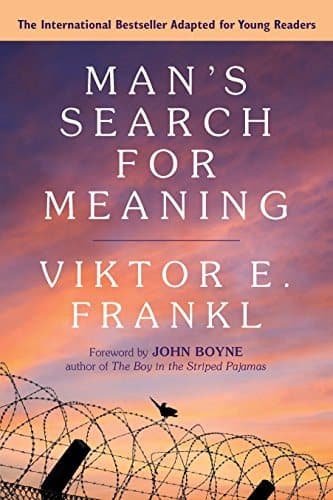
Man's Search for Meaning
We can't always choose what happens — we can choose what it means.
The big idea
A Holocaust survivor and psychiatrist, Frankl draws from his concentration camp experience to argue that the deepest human drive is not pleasure or power, but meaning. Those who survived the camps, he observed, were often those who held onto a why — a person to live for, work to finish, a purpose. Out of this came logotherapy: the therapeutic search for meaning even in unavoidable suffering.
Between stimulus and response there is a space; in that space lies our freedom.
Viktor Frankl was deported to Theresienstadt in 1942 and ended up in Auschwitz, then Kaufering, then Türkheim, surviving until liberation in April 1945. His pregnant wife Tilly, his parents, and his brother all died in the camps. He arrived as a Viennese psychiatrist with a manuscript on logotherapy hidden in his coat lining; the manuscript was confiscated and burned within hours. What he made out of those three years is the foundation of the most-quoted line in twentieth-century psychology.
Suffering ceases to be suffering the moment it finds a meaning.
After the war, an elderly general practitioner came to Frankl's Vienna clinic in deep depression. His wife, whom he had loved beyond measure, had died two years earlier. Frankl listened to the catalog of grief, then asked one question: 'What would have happened, doctor, if you had died first, and your wife had to survive you?' The man answered immediately: 'Oh, for her this would have been terrible. How she would have suffered!'
Meaning is found through work, through love, and through how we face unavoidable pain.
Frankl identifies three avenues to meaning, and the structure has remained the foundation of logotherapy for seventy years. First, by creating a work or doing a deed — the path of contribution. Second, by experiencing something or encountering someone — the path of love and beauty. Third, by the attitude we take toward unavoidable suffering — the path that remains open when the first two have closed.
Don't aim at success — aim at something larger than yourself; success follows.
In his 1992 preface, written nearly fifty years after liberation, Frankl observed that the postwar generations of his American readers had inherited an obsession with happiness that produced its opposite. The harder Americans pursued happiness as a target, the further it receded. He had watched the same dynamic in 1930s Vienna and again in postwar prosperous America: suicide rates rose with material comfort, and meaning-vacuum suffering — what he termed noögenic neurosis — became a clinical category in its own right.
Everything can be taken from a person but the last freedom: to choose one's attitude.
By the time Frankl arrived at Auschwitz, the SS had already taken his manuscript on logotherapy, his clothes, his hair, his name (replaced by the number 119,104), and would soon take his wife (who would die in Bergen-Belsen) and his parents. His material identity was stripped to nothing within forty-eight hours. What he discovered, in the gap between the first day and the second, was that one freedom remained that the camps could not reach.
Tragic optimism: saying yes to life despite suffering, guilt, and death.
Frankl coined the term 'tragic optimism' in his 1984 postscript, written nearly four decades after the original book. He had watched survivors of the camps confront new sufferings — bereavement, illness, aging — that even a victorious life cannot escape. The camps had been the worst, but they were not the only. A philosophy that worked only for that suffering and then collapsed for ordinary tragedy would not have been a philosophy at all.
Live as if you were living for the second time and had acted wrongly the first.
Frankl called this his 'categorical imperative' of logotherapy, in deliberate echo of Kant. The instruction confronts you with life's finiteness and your responsibility for what you do with it; it elicits the conscience by simulating the perspective of the deathbed. He used it on patients to evoke a fierce sense that their choices today have weight that ordinary forward-looking thinking systematically underestimates.
The takeaway
Frankl's argument was forged in Auschwitz: meaning is the only durable fuel, and the freedom to choose your response is the one thing that cannot be taken from you. Suffering becomes bearable only when it serves something larger than itself — a person awaiting your love, a work awaiting your hand, an attitude summoned by the unavoidable. You leave less interested in chasing happiness and more interested in finding what life is asking of you.